The importance of SMD technology in the electronics industry
Surface Mount Device (SMD) technology is one of the core technologies in modern electronic product manufacturing.
It directly installs electronic components on the surface of circuit boards. Compared with the traditional through-hole technology, SMD has higher integration, smaller volume, lighter weight and lower cost.
In the field of LED lighting, SMD technology also plays a crucial role, greatly promoting the miniaturization, lightweighting and high-performance development of LED lamps.
What is SMD surface mount technology?
SMD surface mount technology refers to the technique of directly soldering the pins of electronic components onto the surface of a printed circuit board (PCB).
Compared with the traditional through-hole technology, SMD components do not need to pass through the through-holes on the PCB but are directly attached to the PCB surface and soldered through processes such as reflow soldering.
This technology significantly increases the component density of circuit boards, thereby achieving miniaturization and lightweighting of circuit boards.
The packaging structure and characteristics of SMD LEDs
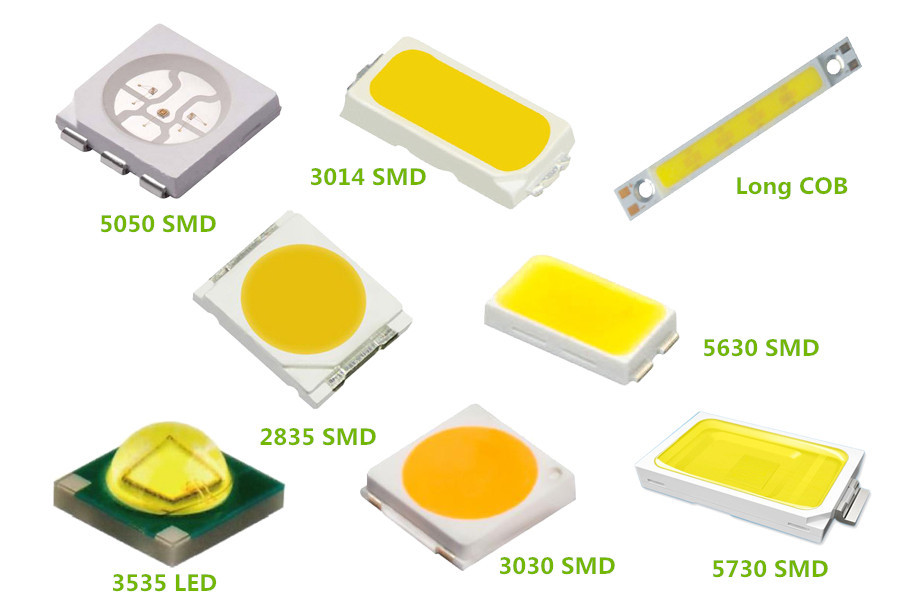
SMD LEDs are typically in a small package form. Their chips are encapsulated on a small plastic or ceramic base and have two or more pins LED out for easy soldering onto a PCB.
Common SMD LED package types include 0603, 0805, 1206, 2835, 3528, etc.
These numbers represent the package size (unit: millimeters). SMD LED packaging has a compact structure, high luminous efficiency and is easy to achieve automated production.
The advantages and applications of SMD LED
SMD LEDs have the following significant advantages:
Compact size: Suitable for high-density circuit board design, making the lamp thinner and lighter.
Lightweight: Reduces the overall weight of the lamp, making it convenient for installation and transportation.
Easy installation: High efficiency of automated production and reduced manufacturing costs.
High luminous efficiency: Optimized packaging design enhances light extraction efficiency.
Low cost: Large-scale production reduces the unit cost.
SMD LEDs are widely used in various LED lighting fixtures, including indoor lighting (downlights, panel lights, light strips), outdoor lighting (street lights, landscape lights), and backlights for display screens, etc.
A comparison between SMD LED and other LED packaging methods
Compared with other LED packaging methods (such as DIP, COB, and CSP), SMD LEDs have obvious advantages in terms of volume and cost, but their heat dissipation performance is relatively weak.
High-power SMD LEDs require more effective heat dissipation designs.
COB packaging has higher luminous efficacy and better heat dissipation performance, but its cost is relatively higher. CSP packaging is more compact, but it is more technically challenging.
Installation and soldering of SMD LEDs
The installation of SMD LEDs typically employs reflow soldering technology, where LED components are attached to the PCB surface and then the solder paste is melted through high-temperature heating to achieve soldering.
Automated reflow soldering equipment can achieve high-efficiency and high-precision soldering of SMD LEDs, ensuring the quality and reliability of the lamps.
The future development trend of SMD technology
In the future, SMD technology will develop in the direction of higher integration, higher efficiency, smaller size, and lower cost.
Mini-LED and micro-LED technologies will further enhance the performance of SMD LEDs and expand their application scope.
Summary: SMD technology drives the progress of LED lighting technology
SMD surface mount technology has achieved remarkable success in the field of LED lighting.
Its advantages of miniaturization, lightweight, high efficiency and low cost have promoted the wide application of LED lamps.
With the continuous development of technology, SMD LED will play a greater role in the future lighting field, providing people with higher-quality and more energy-efficient lighting solutions.