Lighting plays a crucial role in pig production, impacting everything from pig health to productivity and overall welfare. The right lighting system not only helps optimize pig growth but also enhances comfort, reduces stress, and improves overall pig farm management. In this guide, we’ll explore the key points of lighting for pig production, focusing on the critical aspects that every pig producer should consider when setting up a lighting system.
1. Why Lighting Matters in Pig Production
Proper lighting is one of the most important environmental factors in pig production. Pigs, like other livestock, are sensitive to their surroundings, and the lighting conditions can have a significant effect on their behavior, growth, and health.
Here’s why lighting is crucial:
- Regulates Biological Rhythms: Just like humans, pigs have biological rhythms that are influenced by light. Proper lighting helps synchronize these rhythms, contributing to better growth, reproductive performance, and overall well-being.
- Promotes Healthy Behavior: Stress is one of the biggest challenges in pig farming. The right lighting can reduce aggression, competition, and fighting among pigs by creating a calm, comfortable environment.
- Supports Growth and Productivity: By providing appropriate light levels, you can encourage pigs to eat and drink more efficiently, ultimately leading to better weight gain and higher productivity.
2. Choosing the Right Light Intensity for Pig Welfare
When setting up lighting for pig production, it’s essential to choose the right light intensity for different phases of pig development. The intensity of the light affects the pigs’ behavior and growth rate.
- Piglets: Newborn pigs are sensitive to lighting, and they require low-intensity, warm light to make them feel secure and comfortable. A softer, warmer light reduces stress and encourages proper nursing behavior.
- Growing Pigs: As pigs grow, they require slightly higher light levels to support their natural activity levels. Too much light can cause stress, while too little light can result in underactive pigs.
- Adult Pigs and Sows: For adult pigs and sows, the light intensity can be adjusted depending on the stage of reproduction. Sows need consistent light for optimal breeding, while gestating sows may benefit from dimmer, less harsh light to reduce stress during pregnancy.
The ideal light intensity for pigs typically falls between 50 to 100 lux in their environment. However, it is important to adjust lighting based on the specific needs of the pigs.
3. Light Duration and Photoperiod Management
The duration of light exposure, known as the photoperiod, is another important factor in pig production. Research has shown that pigs thrive with a consistent daily routine, which includes the correct duration of light exposure.
- For Piglets and Growers: Maintaining a consistent 16 hours of light followed by 8 hours of darkness helps maintain a natural rhythm and promotes healthy growth. This mimics a natural day/night cycle and helps keep the pigs calm.
- For Sows and Breeding Pigs: Breeding pigs benefit from a controlled photoperiod of 14 to 16 hours of light per day. This increases breeding efficiency and enhances reproduction rates by stimulating hormone production.
By regulating the light-dark cycle, you can improve pig reproductive success, as well as optimize their feeding and sleeping patterns.
4. Color Temperature of Lighting for Pigs
The color temperature of the lighting also plays a significant role in pig production. Pigs are sensitive to various wavelengths of light, which can influence their behavior and stress levels.
- Warm White Light (2700K – 3000K): This is the most common light for piglets and growing pigs. The warm, yellowish light promotes comfort and relaxation, which is important for reducing stress.
- Cool White Light (4000K – 5000K): This type of light is often used for adult pigs and sows, especially during the breeding and lactation phases. Cool white light encourages activity and feeding behavior, but it can also increase stress if used excessively.
- Daylight (5000K – 6500K): High-intensity, daylight-spectrum light is beneficial for adult pigs, especially in breeding or outdoor environments, where they are exposed to natural light. However, it should not be used in excess, as it can be overstimulating.
Choosing the correct color temperature helps mimic the natural environment and prevents discomfort or overstimulation in pigs.
5. LED Lighting for Pig Production: Energy-Efficient and Long-Lasting
LED lighting is a popular choice for pig production due to its many benefits. It provides high light intensity and long-lasting performance while consuming much less energy than traditional incandescent or fluorescent lighting.
Here are some benefits of using LED lighting in pig production:
- Energy Savings: LED lights are highly energy-efficient and consume up to 80% less energy than traditional lighting. This reduces operating costs for farms and makes it a sustainable choice.
- Long Lifespan: LED lights last much longer than traditional lights, reducing the frequency of replacement and the overall maintenance costs.
- Customizable Options: LEDs come in a variety of light intensities and color temperatures, making them ideal for customizing lighting setups to meet the needs of different pigs at different stages of production.
To learn more about the benefits of LED lighting in agriculture, check out this Energy Star LED Guide.
6. Automated Lighting Systems for Pig Farms
In modern pig farming, automated lighting systems offer enhanced control and efficiency. These systems can adjust light intensity and duration based on the time of day, the type of pigs, and the phase of production.
- Light Sensors and Timers: Automated systems can include timers and sensors that adjust light levels automatically based on the time of day or activity levels in the barn. This helps optimize energy use while ensuring the pigs are exposed to the appropriate lighting conditions.
- Smart Control Systems: For larger farms, smart lighting systems that integrate with farm management software can be used to control and monitor lighting remotely, further reducing labor costs and improving operational efficiency.
Conclusion: Optimizing Lighting for Pig Production
In conclusion, the key points of lighting for pig production are vital to creating an optimal environment for growth, reproduction, and overall pig welfare. By choosing the right light intensity, color temperature, and photoperiod, farmers can improve productivity and reduce stress among their pigs. The use of energy-efficient LED lighting and automated systems further enhances the efficiency and sustainability of the farm.
Proper lighting not only improves pig welfare but also contributes to higher productivity, healthier pigs, and better financial outcomes for producers. Whether you’re just starting with lighting setups or looking to optimize your current system, understanding these key points is the first step toward improving your pig production system.
Visual spectrum distribution diagram of pig eyes:
The visual spectrum distribution diagram of pig eyes is shown in Figure 1. The wavelength range of the pig visual spectrum is 350-650 nm. There are two response peaks (439nm and 556nm) in the range of 430-450 nm and 540-570 nm. The sensitivity reaches the maximum at 540-570 nm. In addition, there is a visual response in the ultraviolet band of 350-400 nm. Pigs are not sensitive to red light. The most significant difference between human vision and pig eyes is the ability of the pig eye’s retina to perceive ultraviolet light. At the same time , pig vision has no visual response to red light with a wavelength greater than 650nm.
The spectral design of pig lamps needs to follow the visual response distribution of pig eyes , which can reduce the power consumption of lamps, improve the visual comfort of pigs and allow the spectral distribution of pig lamps to be described by color temperature or spectral morphology diagram.
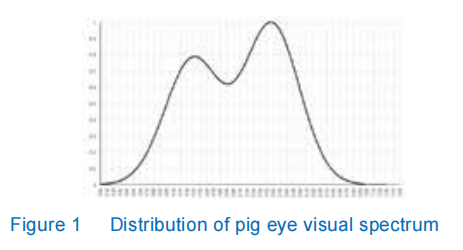
There are two peaks in the spectral sensitivity of pig eyes , with wavelengths of 439 nm and a wavelength of 556nm. The spectral sensitivity of pig eyes and human eyes is quite different. The response range of pig vision to photon wavelength is 350-650 nm. By optimizing the lighting spectrum of pig houses , a suitable lighting environment is provided for domestic pigs , thereby increasing health and growth and minimizing energy consumption and feed expenditure.
Pig light intensity and time
Pig lamps belong to the application category of low photon flux density, and the light level is between 500-1950 nmol/m2s (40-150lx). When the ground SPFD is lower than 80 nmol/m2s (lower than 5lx), it is evaluated as a dark period. Studies have shown that higher intensities (greater than 240 lux) suppress the established melatonin rhythm.
The light distribution with light uniformity as an indicator is an important setting for bio-optical applications. Uniform light will ensure the comfort of the pig herd. Different pig species and different growth periods have different light levels. Domestic pig lamps need to be comprehensively considered based on the absorption and reflection of the spectrum by the pig house structure and the ground.
In the wavelength range of 400-650 nm, in order to facilitate the observation habits of breeders, it is allowed to use the illumination (lx) of human vision to calculate certain parameters. However, it is necessary to clearly understand that the response of organisms in the spectrum is generated by photons of different energies rather than the illumination (lx) of the human eye to cause a biological visual response. This light level specification does not include the setting of near-ultraviolet light levels.
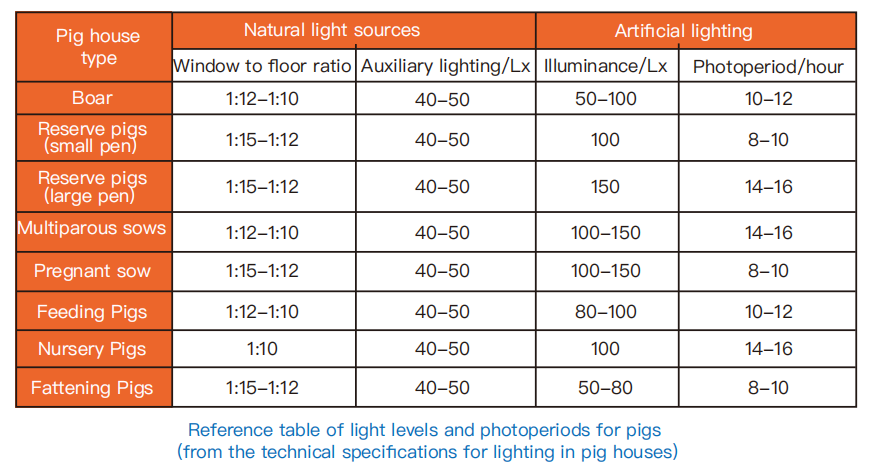
This specification provides reference table 1 for the setting of light levels for domestic pigs. Please make appropriate adjustments according to the specific light source spectrum application.
Photoperiod for pig farming
The photoperiod cycle is a physiological control of the metabolic activity of pigs , regulating the biological clock and glands. Photoperiod adjustment can control growth rate , estrus or delayed estrus , and can also control weight , bone calcium absorption , survival rate , etc. The dark cycle drives immune function , reproductive hormones and improves health. Fattening pigs promote more feed consumption by extending the photoperiod, while piglets need to set the photoperiod to 24 hours to help piglets find milk.
Findings on lighting for estrus and pregnancy in sows show that a daily photoperiod of 12 to 16 hours followed by at least 8 hours of darkness (red) is most beneficial, while 15 to 16 hours is recommended for delivery room lighting. The lighting of nurseries and finishing rooms is recommended to be 8 hours of dark time and 30 minutes of sunrise/sunset simulation to reduce stress caused by sudden changes from dark to light (or vice versa).
The choice of a light cycle setting in natural light is more conducive to pigs eating. Light cycle calculation allows the light cycle to be set in segments (intermittent lighting) and different ways of light cycle adjustment are called artificial light management. It is allowed to adjust the photoperiod to a decreasing mode during the growing period.
In short, in pig production , appropriate light intensity timing and photoperiod can establish healthy rhythms, reduce stress responses and improve animal welfare.
Enhance blood circulation
Increase the growth rate of pigs
Promote metabolism
Optimize feed ratio and reduce feed costs
Promote calcium absorption
Enhance immunity and reduce mortality