
In commercial and office spaces, safety and compliance with lighting regulations are paramount. Self-test emergency downlights play a crucial role in ensuring that lighting systems remain operational during power failures and that they meet stringent safety standards. Whether in corridors, office spaces, or public buildings, these lighting solutions provide a reliable, energy-efficient way to maintain visibility during emergencies. In this article, we’ll explore why self-test emergency downlights are essential for safety, how they ensure compliance, and the benefits they offer for offices and corridors.
1. What Are Self-Test Emergency Downlights?
Self-test emergency downlights are specialized lighting fixtures designed to automatically test their functionality. These lights feature built-in diagnostic capabilities, allowing them to perform periodic self-checks to ensure they remain operational when needed. In the event of a power failure, self-test emergency downlights instantly switch to battery power, providing critical illumination for safe evacuation or navigation.
Unlike traditional emergency lights, self-test downlights don’t require manual inspections or testing by facilities staff. The built-in self-testing feature ensures that the lights are always ready for use, and any potential failures are flagged for repair or replacement.
2. Ensuring Compliance with Safety Regulations
In many jurisdictions, commercial and office spaces are required by law to have emergency lighting systems that operate during power outages. Self-test emergency downlights help ensure compliance with safety regulations such as the UK’s BS 5266-1:2016, which mandates that emergency lighting must be capable of illuminating escape routes and provide sufficient light for safe evacuation.
These downlights meet the legal requirements by offering reliable emergency lighting and automatic self-testing. The built-in diagnostic system ensures that the lighting meets the necessary standards for performance, making it easy to prove compliance during inspections.
For more information on emergency lighting standards, visit the Health and Safety Executive’s guide on emergency lighting.
3. Energy Efficiency and Cost Savings
One of the significant advantages of self-test emergency downlights is their energy efficiency. Traditional emergency lights often run continuously or require manual inspection, both of which waste energy. Self-test emergency downlights, on the other hand, only consume energy during the self-testing process or when operating on backup power during a power failure.
LED technology is commonly used in these downlights, offering even greater energy efficiency. LED emergency downlights use far less energy than incandescent or fluorescent lights, providing significant cost savings over time. These lights are also designed to last longer, with LED bulbs offering up to 50,000 hours of operation.
By reducing energy consumption and maintenance needs, self-test emergency downlights contribute to both financial and environmental sustainability.
4. Enhanced Safety During Emergencies
Self-test emergency downlights are an essential part of any emergency lighting system. During power failures, these lights ensure that critical areas, such as escape routes and corridors, are adequately illuminated. This allows people to safely evacuate or navigate the premises without the risk of injury.
The self-testing feature ensures that the lights are always in good working condition and ready to activate when needed. By eliminating the need for manual testing, these downlights provide greater peace of mind and reduce the risk of failure during an emergency.
5. Easy Maintenance and Monitoring
One of the key benefits of self-test emergency downlights is the ease of maintenance. Traditional emergency lighting systems require regular inspections to ensure they are functioning correctly. However, self-test emergency downlights automatically conduct periodic tests and provide real-time diagnostics, alerting facilities managers if any issues arise.
This self-monitoring capability reduces the need for manual checks, saving both time and money. Facilities managers can easily review the status of the lighting system through the indicator lights or digital reports, ensuring that all systems are functional and ready for emergencies.
6. Ideal for Corridors and Office Spaces
In office environments, corridors, and hallways, self-test emergency downlights provide an effective and efficient lighting solution. These areas often require illumination during power outages to ensure safe passage, especially in larger buildings or multi-story offices. The self-test emergency downlights are designed to be unobtrusive yet provide powerful illumination when needed.
With their sleek, low-profile design, self-test emergency downlights integrate seamlessly into the architecture of corridors, hallways, and office spaces. They are available in various finishes and sizes to match the décor of the space, making them an aesthetic and functional solution for commercial buildings.
7. Durability and Reliability
Built for high-performance, self-test emergency downlights are designed to withstand the demanding conditions of commercial spaces. They are durable, reliable, and capable of functioning even in extreme temperatures, ensuring that they can perform effectively in any environment.
The rugged construction and high-quality components of these downlights ensure that they are a long-lasting investment, reducing the frequency of replacements and minimizing maintenance costs. Whether used in offices, warehouses, or public spaces, self-test emergency downlights are built to provide consistent, reliable lighting.
Conclusion: Why Self-Test Emergency Downlights Are a Smart Investment
Self-test emergency downlights are a smart investment for any office or commercial building. Not only do they provide essential safety lighting during power failures, but they also ensure compliance with safety regulations and contribute to energy efficiency. The self-testing feature removes the need for manual inspections and guarantees that the lights are always operational when needed.
For businesses looking to maintain a safe and compliant environment while also reducing energy costs, self-test emergency downlights are an ideal solution. Their easy maintenance, long lifespan, and reliable performance make them a crucial part of any lighting system, ensuring safety and peace of mind for all occupants.
FAQs
1. What makes the SPL-SET16’s “Adaptive Dual-Mode” lighting unique for emergencies?
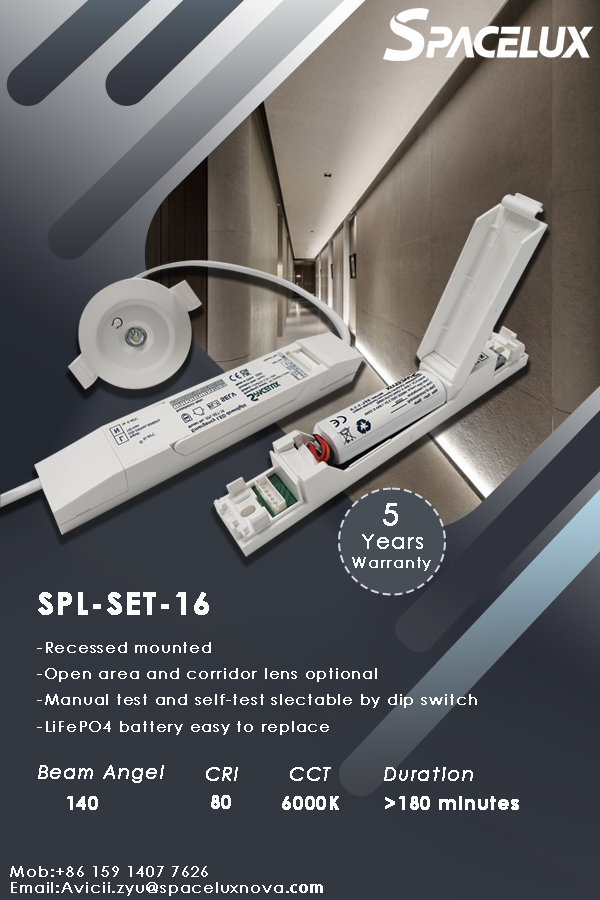
The SPL-SET16 offers selectable Corridor and Open Area lighting modes, providing optimized illumination for diverse environments.
Corridor mode delivers a focused beam for clear path visibility, while Open Area mode provides broader illumination.
This adaptability ensures optimal light distribution, enhancing safety and efficiency during emergencies without requiring separate fixtures.
2. How long does the SPL-SET16’s battery provide emergency illumination, and what type of battery is used?
The SPL-SET16 provides certified 180-minute (3-hour) emergency illumination, ensuring ample time for safe evacuation during power outages.
It utilizes a long-lasting LiFePO₄ battery, known for its superior performance and extended lifespan compared to traditional battery technologies.
This reduces the frequency of battery replacements, minimizing maintenance costs and downtime.
3. What is the advantage of tool-free battery replacement in the SPL-SET16?
The tool-free LiFePO₄ battery replacement feature significantly simplifies maintenance procedures.
This design eliminates the need for tools during battery changes, saving time and reducing labor costs.
It also minimizes the risk of damage during battery replacement, ensuring the longevity of the fixture.
4. What makes the SPL-SET16 suitable for both corridor and open-area applications?
The SPL-SET16’s compact design and selectable lighting modes make it ideal for both corridors and open areas. Its small size allows for discreet integration into various ceiling designs, while the selectable modes ensure optimal light distribution for each application.
This versatility reduces the need for multiple fixture types, simplifying inventory management and installation.
5. How does the SPL-SET16 improve maintenance efficiency in emergency lighting systems?
The SPL-SET16 redefines maintenance efficiency through its combination of features: long-lasting LiFePO₄ battery, tool-free battery replacement, and selectable lighting modes.
These features minimize downtime, reduce labor costs, and simplify compliance testing, resulting in significant cost savings and improved operational efficiency for building managers.


