LED technology has transformed modern lighting by offering energy efficiency, long lifespan, and high reliability. However, behind the glowing brilliance of every LED is a fundamental electrical parameter known as forward voltage in LED lighting. Understanding forward voltage (often abbreviated as Vf) is essential for engineers, lighting designers, and even hobbyists because it directly impacts how an LED emits light, how circuits are designed, and how power efficiency is managed.
In this comprehensive guide, we’ll break down what forward voltage is, why it matters, how it affects LED performance, and what you need to know to optimize LED-based lighting systems.
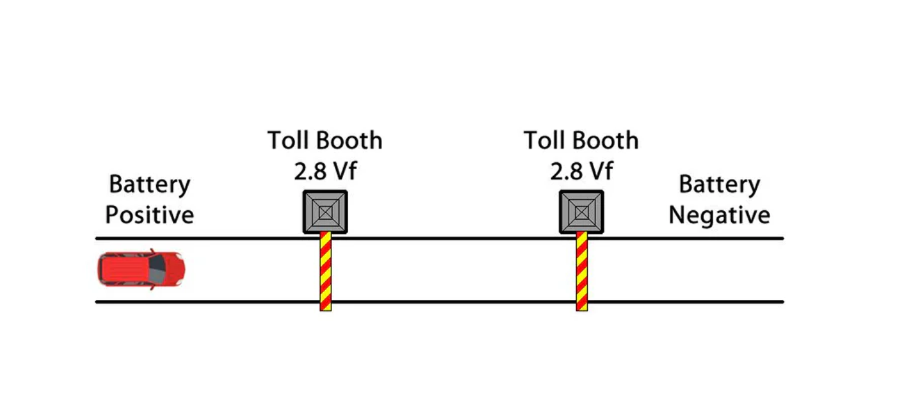
What is Forward Voltage in LED Lighting?
At its core, forward voltage in LED lighting refers to the minimum voltage that must be applied across an LED for current to flow and light emission to occur. Unlike traditional resistive loads such as incandescent bulbs, LEDs are semiconductor diodes.
- When forward-biased (positive to the anode, negative to the cathode), electrons cross the junction and recombine with holes, releasing energy in the form of photons, which we see as light.
- This energy barrier must be overcome before conduction begins, and the voltage that accomplishes this is the forward voltage (Vf).
Typical forward voltage values:
- Red LEDs: 1.8V – 2.2V
- Green LEDs: 2.0V – 3.2V
- Blue & White LEDs: 3.0V – 3.6V
The exact Vf depends on the semiconductor material, wavelength of light emitted, and LED design.
Why Forward Voltage Matters in LED Applications
The role of forward voltage in LED lighting is not just a textbook concept—it’s critical for real-world performance and safety. Here’s why:
- Determines Power Requirements
- Power (P) = Voltage (V) × Current (I).
- A 3.2V white LED at 20mA consumes about 64mW, but multiple LEDs in series multiply that requirement.
- Influences Circuit Design
- Engineers must choose the right power supply and current-limiting components based on Vf.
- Affects Brightness and Efficiency
- Vf variations affect current flow; higher currents produce more light but also more heat, reducing lifespan.
- Impacts Heat Management
- Excess current due to low resistance or supply mismatches can cause thermal runaway.
In short, without properly accounting for forward voltage, LED systems risk inefficiency, overheating, or complete failure.
The Science Behind Forward Voltage in LED Lighting
To fully grasp why forward voltage exists, it helps to review the semiconductor physics of LEDs.
The P-N Junction
LEDs consist of p-type and n-type semiconductors. The junction forms a barrier (bandgap energy). Applying forward voltage pushes electrons and holes together, bridging this energy gap.
Photon Emission and Wavelength
The bandgap determines both the forward voltage and the color of light emitted:
- Narrow bandgap → lower Vf → red/orange light.
- Wide bandgap → higher Vf → blue/white light.
This is why forward voltage values differ across LED colors.
Measuring Forward Voltage in LED Lighting
Engineers and technicians frequently measure Vf to ensure LEDs are functioning properly. Methods include:
- Multimeter Diode Test Mode – Gives an approximate Vf.
- Power Supply & Resistor Setup – More precise, applying known current and measuring voltage drop.
- Automated Test Systems – Used in LED manufacturing for binning and quality control.
The key point: Forward voltage must always be referenced under specific test current conditions (e.g., Vf @ 20mA).
Factors Affecting Forward Voltage
Several variables influence the forward voltage in LED lighting:
- Material & Color
- Different band gaps = different Vf values.
- Current
- Higher current slightly increases Vf.
- Temperature
- Vf decreases with increasing junction temperature (≈ -2mV/°C).
- Manufacturing Tolerances
- Even LEDs from the same batch may have ±0.1V variation.
- Aging & Degradation
- Over time, Vf shifts slightly due to material stress.
These variations must be accounted for in design, especially when running multiple LEDs in series or parallel.
Forward Voltage in Series vs. Parallel LED Circuits
Understanding Vf is crucial when wiring LEDs:
Series Connection
- Total Vf = sum of individual forward voltages.
- Example: 3 white LEDs at 3.2V each → total Vf = 9.6V.
- Ensures equal current through all LEDs.
Parallel Connection
- Each LED experiences the same supply voltage.
- Risk of uneven current distribution if Vf varies between LEDs.
- Requires current-balancing resistors or driver ICs.
For reliability, series configurations are preferred in professional lighting systems.
Forward Voltage and LED Drivers
LED drivers regulate current because LEDs are current-driven devices, not voltage-driven. Forward voltage is used to determine driver specifications.
- Constant Current Drivers: Adjust voltage to maintain set current despite Vf variations.
- Constant Voltage Drivers: Require external resistors or regulators to limit current.
For high-power LEDs, constant current drivers are almost always recommended.
Example resource on LED drivers
- “Higher Vf means brighter LED” – Not always true; brightness depends on current and efficiency.
- “All LEDs of the same color have identical Vf.” – Manufacturing differences exist.
- “You can ignore Vf if you use a resistor” – Incorrect; Vf determines resistor value and power efficiency.
Practical Design Considerations
When working with forward voltage in LED lighting, always:
- Refer to the LED datasheet for the typical and maximum forward voltage (Vf).
- Ensure the power supply provides enough headroom.
- Consider the Vf drop with temperature rise.
- Avoid running LEDs near maximum current to extend life.
Real-World Applications of Forward Voltage in LED Lighting
Forward voltage plays a role across industries:
- Consumer Electronics: LED indicators and backlights.
- Automotive Lighting: High-power LEDs with strict Vf and current requirements.
- Architectural Lighting: Long LED strips require accurate Vf calculations to avoid uneven brightness.
- Medical Devices: Stable Vf ensures consistent illumination in diagnostic tools.
Troubleshooting Issues Related to Forward Voltage
Symptoms of improper Vf management include:
- LEDs not lighting: Supply voltage below the required Vf.
- Dim or flickering LEDs: Driver unable to maintain consistent current.
- Overheating LEDs: Excess current due to ignoring Vf variations.
Solutions involve adjusting the power supply, adding proper resistors, or using regulated drivers.
Future Trends: Forward Voltage in Next-Gen LEDs
As LED technology advances, manufacturers are striving to reduce forward voltage to improve efficiency. Emerging materials like Gallium Nitride (GaN) and Quantum Dot LEDs may achieve lower Vf with higher brightness.
This evolution will continue to shape energy-efficient lighting systems, making Vf an even more critical parameter.
Conclusion
Understanding forward voltage in LED lighting is the key to unlocking the full potential of LED systems. From determining brightness and efficiency to ensuring safe circuit design, Vf is central to every application.
By considering forward voltage during design and installation, you can achieve:
- Higher energy efficiency
- Longer LED lifespan
- Safer and more reliable operation
As LED technology continues to evolve, forward voltage remains a fundamental parameter that connects the physics of semiconductors to the brilliance of modern lighting.