
Table of Contents
- Switzerland’s T8 Fluorescent Sales Ban: What Happened on 1 September 2025
- The Scale of the Problem: How Many Buildings Are Affected
- Why LED Batten Lights Are the Direct and Practical Replacement
- Performance Gains: Energy, Maintenance and Light Quality
- Three Retrofit Options — and Why Complete LED Battens Win
- The Belgian and European Market Context
- What Contractors, Distributors and Dealers Need to Know
- How Spaceluxnova Supports Your Projects
- Sources
Switzerland’s T8 Fluorescent Sales Ban: What Happened on 1 September 2025
On 1 September 2025, Switzerland completed the final phase of its fluorescent lamp phase-out. T8 linear fluorescent tubes — the 26 mm diameter, G13-socket lamps that dominate the ceiling lighting of offices, workshops, warehouses, schools, retail spaces, and car parks across Switzerland — became illegal to sell. The import ban had already been in force since August 2023, meaning Swiss stocks were steadily depleting; the 1 September 2025 date closed the final window of sell-through stock.
Switzerland followed the EU’s framework based on Directive 2011/65/EU (RoHS — Restriction of Hazardous Substances) and the Ecodesign Regulation. The ban targets mercury-containing light sources. A single T8 fluorescent tube contains up to 5 mg of mercury, a substance that endangers human health and the environment when lamps are broken or improperly disposed of. Beyond the mercury argument, T8 technology is significantly less energy-efficient than LED alternatives: mercury-free LED replacements consume approximately half the electricity of a conventional T8 tube for equivalent light output.
The Swiss Federal Office of Energy (SFOE/SFOE, BFE) has long embedded this transition in Switzerland’s Energiestrategie 2050. The country’s lighting industry agreed in 2018 at the European Light Congress in Davos to halve lighting-related energy consumption from 7 TWh/year to 3.5 TWh/year by 2025 — a target representing roughly 12% of Switzerland’s total electricity consumption shifted toward high-efficiency LED technology. The T8 ban is the enforcement mechanism that makes the final leg of this transition unavoidable.
The Swiss lighting distribution sector has confirmed the practical consequences: nationwide, stocks of T8 fluorescent tubes are at or near zero. Electrical distributors in Switzerland are explicitly warning commercial operators that where T8 installations are still running, failures will now result in a complete inability to source replacement tubes — not a shortage, but a permanent market exit.
The Scale of the Problem: How Many Buildings Are Affected
The scale of the forced retrofit requirement is substantial. According to EU estimates, approximately 250 million T5 and T8 fluorescent tube installations were in use across Europe at the time of the ban, requiring replacement over six years. Switzerland, with its dense commercial real estate base of offices, industrial halls, retail, logistics, and public buildings, accounts for a significant share of installed Central European fluorescent infrastructure.
Swiss industry experts, including lighting specialists at EKZ Eltop and the Swiss electrical trade body EIT.swiss, confirm that T8 fluorescent tubes remain in widespread operation across:
- Offices and administrative buildings — whether open-plan corporate headquarters, SME office parks, or public authority buildings, T8 battens and trunking systems are the dominant ceiling lighting technology in pre-2015 stock
- Workshops and production facilities (Werkstätten, Betriebe) — T8 surface-mounted battens and industrial IP65-rated fittings are standard in light manufacturing, joinery workshops, garages, and technical service environments
- Retail and commercial spaces (Läden, Verkaufsräume) — back-of-house, storage, and service areas of retail units routinely rely on T8 batten installations that have not been renovated since fitout
- Underground car parks and service corridors — T8 in weatherproof batten housings (typically IP44 or IP65) is the standard for parking structures in Swiss commercial real estate
- Stairwells, corridors, and common areas of apartment blocks and mixed-use buildings — the powernewz.ch replacement guide specifically cites stairwells and underground car parks as primary LED retrofit candidates
EKZ, the major Zurich cantonal utility, has stated plainly: whether the building is an office, industrial, or residential property, there is no escaping the replacement of fluorescent lamps over the next one to three years. Every failed T8 in a commercial installation is now an immediate LED retrofit project — there is no alternative tube to order.
Why LED Batten Lights Are the Direct and Practical Replacement
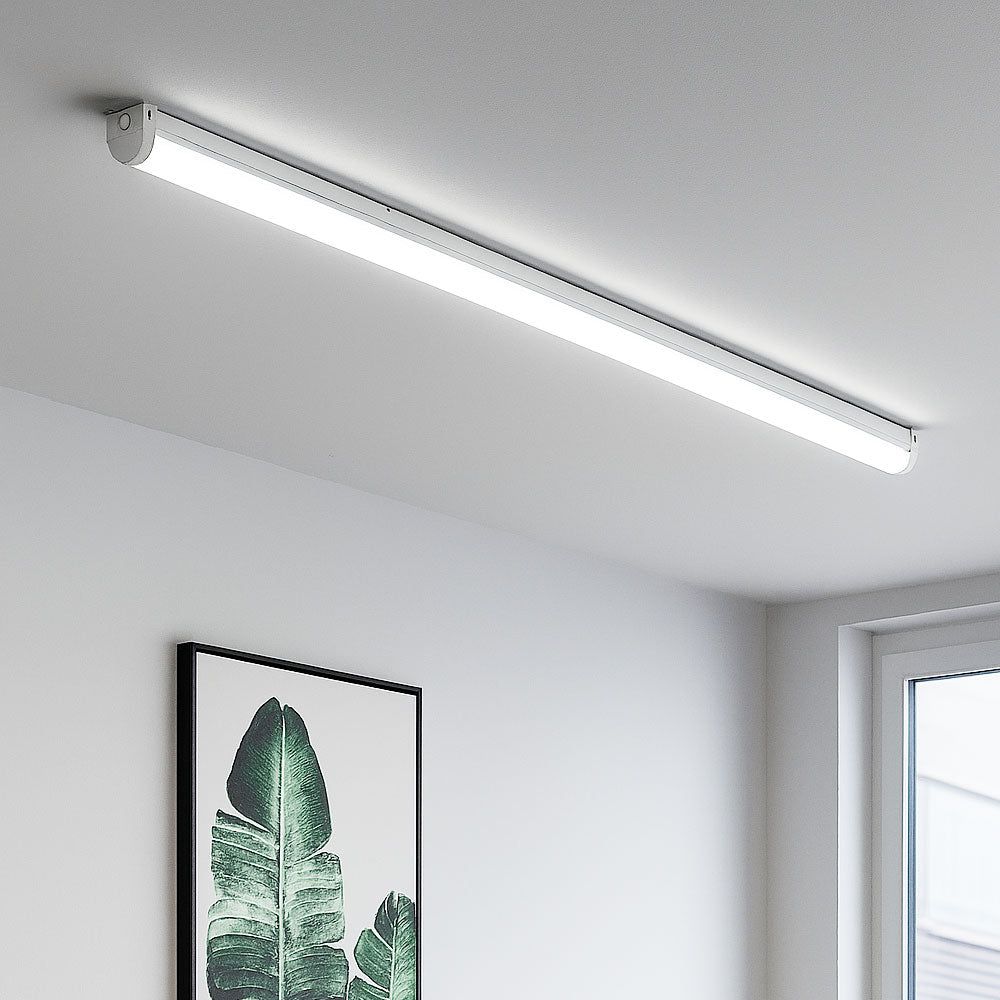
An LED batten light is an integrated LED luminaire in a slim, elongated housing, available in standard lengths (600 mm / 1,200 mm / 1,500 mm) that correspond directly to T8 fluorescent tube fittings. Unlike retrofit LED tubes — which are inserted into existing fluorescent housings — a complete LED batten light replaces the entire fitting: housing, driver, and light source in one integrated unit.
This direct dimensional and functional correspondence makes LED battens the default replacement choice when a T8 fluorescent installation fails or requires a full upgrade. The applications are identical: offices, workshops, car parks, stairwells, corridors, retail stockrooms, warehouses, schools, industrial spaces, and any other commercial environment where T8 surface-mounted or suspended battens previously provided general ambient or task lighting.
LED batten lights are available in two key variants relevant to the Swiss commercial retrofit market:
- Standard IP20 indoor battens — for dry commercial interiors, including offices, retail floors, schools, and production areas without moisture exposure. Available in 3,000 K / 4,000 K / 6,500 K colour temperatures, with opal or clear diffusers.
- IP65-rated weatherproof battens (tri-proof / vapour-proof) — for car parks, workshops, warehouses, food production areas, cleaning facilities, and any space with moisture, dust, or chemical exposure. The IP65 rating ensures the fitting is fully dust-tight and protected against water jets, satisfying Swiss building codes for wet and potentially wet commercial environments.
Both types mount directly to the ceiling or wall via integral brackets — surface-mount installation that requires no ceiling modification and can typically be completed by an electrician in minutes per fitting point. This speed of installation is commercially critical when retrofitting large commercial floors with hundreds of fitting points under live operating conditions.
Performance Gains: Energy, Maintenance and Light Quality
The business case for replacing T8 fluorescent battens with integrated LED battens is well established across Swiss and European commercial practice:
Energy savings of 50–70%. A standard T8 fluorescent batten (1×36W or 2×36W with magnetic ballast) consumes 40–80W total system power. An equivalent integrated LED batten delivering the same or greater lumen output typically draws 18–36W. Over a 10-hour commercial operating day, across a 50-fitting installation, this represents annual electricity savings of 2,700–7,300 kWh — directly reducing energy bills and contributing to the Swiss Energiestrategie 2050 targets. When combined with presence sensors and daylight harvesting controls, LED systems with intelligent light sources can reduce energy consumption by up to 80–90% compared to unmanaged fluorescent installations.
LED service life of 50,000 hours or more. Fluorescent tubes require replacement every 6,000–25,000 hours. For a commercial space running 10 hours per day, a T8 tube needing replacement every 6,000 hours means a service call approximately every 1.6 years. A 50,000-hour LED batten in the same application requires no lamp change for over 13 years. For building operators managing large installations — office blocks, logistics centres, schools, car parks — the labour cost saving from eliminated relamping routines is as commercially significant as the energy saving.
Immediate start, no flicker, improved colour rendering. LED battens light instantly at full output with no warm-up period, no flicker, and no end-of-life colour shift. Swiss lighting professionals and workplace health advocates note that LED technology with Ra ≥ 80 (and quality products at Ra ≥ 90) provides measurably better colour rendering than standard T8 fluorescent, improving visual comfort for office workers and reducing eye strain in task-intensive environments such as workshops and production areas.
Mercury elimination and simplified waste disposal. T8 fluorescent tubes are classified as hazardous waste in Switzerland and must be disposed of at authorised collection points. Integrated LED battens contain no mercury and are not classified as hazardous waste, simplifying end-of-life handling and reducing the liability of commercial building operators for disposal compliance.
Three Retrofit Options — and Why Complete LED Battens Win
When a T8 installation requires replacement, the market offers three technical options. LEDCity Switzerland, a specialist LED retrofit advisor, sets these out clearly for commercial building managers:
Option 1: LED retrofit tubes (LED tubes fitted into the existing fluorescent housing). The fastest and cheapest initial intervention. ECG-compatible LED tubes drop into the existing fitting. However, the Swiss trade body XAL and other technical advisors note serious drawbacks: fitting CE certification is invalidated by the conversion; luminance and UGR limits for workplace standards (EN 12464-1) may be exceeded since the photometric distribution of the original housing was designed for T8 tubes, not LED point sources; and the ballast may be approaching end of life regardless. Retrofit tubes are also not eligible for energy subsidy programmes in Switzerland and most of Europe.
Option 2: LED tubes with ballast bypass (direct mains LED tubes). The existing housing is used, but the ballast is removed, and the wiring is reconfigured for direct 230V LED tube operation. Lower long-term running costs than ECG-compatible tubes, but the same photometric limitations apply, CE certification concerns remain, and the labour cost of ballast bypass per fitting approaches the cost of full luminaire replacement on larger installations.
Option 3: Complete integrated LED batten luminaires (replacing housing, driver and light source in one unit). The highest initial cost per fitting point, but the option recommended by Swiss technical experts and Swiss electrical wholesalers, including Elektro-Material AG, for most commercial retrofit scenarios. Key advantages: full CE certification maintained; photometric performance designed specifically for LED optics, meeting EN 12464-1 workplace illuminance and UGR requirements; longest service life; eligible for energy subsidy programs (Swiss utility subsidy schemes, canton energy programs); best total cost of ownership over 10 years; and the only option that delivers the full range of smart control features including DALI-2 dimming, presence detection, and daylight harvesting integration.
The Belgian and European Market Context
The Swiss T8 ban is not an isolated event — it is the Swiss instance of a coordinated European phase-out. The same RoHS and Ecodesign regulatory framework applies across the EU, meaning the commercial retrofit dynamic playing out in Switzerland in 2025–2026 applies with equal force in Belgium and across the broader European market.
Belgium’s own fluorescent phase-out followed the same EU timetable. Belgian commercial buildings constructed or last refurbished before 2018 still carry large installed bases of T8 and T5 fluorescent battens in offices, warehouses, public buildings, and industrial facilities. The retrofit pipeline in Belgium is structurally identical to Switzerland’s: failed fluorescent tubes in commercial installations cannot be replaced like-for-like, making LED batten retrofit the only viable path forward.
The scale of this European-wide transition is quantifiable. The global commercial LED lighting market was valued at USD 17.07 billion in 2024 and is projected to reach USD 27.38 billion by 2030. The European indoor LED lighting market was valued at USD 12.88 billion in 2024 and is forecast to grow to USD 34.58 billion by 2032 at a CAGR of 15.2%. The retrofit installation segment commands the largest share of European LED lighting activity — over 60% of the market by installation type — driven precisely by the forced replacement cycle of fluorescent lamp bans. Switzerland’s LED market is projected to grow at a CAGR of 10.5% through 2032, with commercial retrofits as the primary growth driver.
What Contractors, Distributors and Dealers Need to Know
For electrical contractors, electrical wholesalers, and lighting product distributors operating in Belgium and targeting the commercial retrofit market, the Swiss experience provides a direct model of what happens when a fluorescent ban reaches its enforcement endpoint:
Commercial operators are forced to be buyers. Once T8 stocks are gone, there is no optionality. Every commercial building operator managing a space with T8 installations that fail is an immediate retrofit prospect. The buying decision is no longer “should I upgrade?” but “which LED batten product should I buy, and from which distributor can I get it most reliably?” Distributors with guaranteed stock availability, short lead times, and technical support win the contract.
The specification conversation has changed. Building facilities managers, electrical contractors, and project specifiers are no longer asking whether to switch to LED. They are asking: what wattage, what colour temperature, what IP rating, what control protocol, and what installation method. Distributors who can answer all five questions quickly — with product samples, photometric data sheets, and installation guides in hand — close projects that reactive competitors lose.
CE marking and IEC 60598 compliance are non-negotiable. For commercial and industrial installations in Belgium, luminaires must carry a valid CE marking demonstrating conformity with IEC 60598 (luminaire safety), EN 55015 (electromagnetic compatibility), and EN 61547 (immunity). IP ratings must be certified to IEC 60529. Products without traceable certification documentation are a liability risk for electrical installation contractors, who bear responsibility for the safety of the installed system.
IP65 tri-proof battens are a fast-growing segment. Car parks, food service back-of-house, cleaning depots, pharmaceutical production, logistics warehouses, and workshops all require IP65-rated batten fittings. This is a higher-margin segment than standard IP20 office battens, and the volume opportunity is substantial given the large floor areas involved in warehouse and industrial applications.
Energy performance documentation supports subsidy access. In Belgium, the Fluvius EBP programme and other regional energy grant schemes support LED retrofits in non-residential buildings. Supplying documented lm/W efficiency data, LM-80 LED source data, and Energy Star or equivalent certification alongside the product helps building owners and contractors access these subsidies, reducing the upfront investment hurdle and accelerating purchasing decisions.
How Spaceluxnova Supports Your Projects
At Spaceluxnova, our LED batten lighting range is engineered for exactly the commercial retrofit demands that the Swiss T8 ban has made urgent — and that Belgium’s identical regulatory trajectory is replicating across all three regions. Whether you are an electrical contractor replacing T8 installations in an office block in Brussels, a distributor building a commercial-grade batten portfolio for the Belgian market, or an importer seeking a reliable supply partner for tri-proof warehouse fittings, our product range covers:
- Standard IP20 LED battens — surface-mounted, in 600 mm / 1,200 mm / 1,500 mm lengths, available in 3,000 K / 4,000 K / 6,500 K, Ra ≥ 80, direct T8 dimensional replacement for dry office, retail, and commercial interiors
- IP65 tri-proof LED battens — fully sealed against dust and water jets, for car parks, warehouses, workshops, food preparation areas, and all wet or potentially wet commercial environments; available in the same standard lengths
- Emergency conversion module-compatible battens — suitable for integration of self-test emergency modules, meeting Belgian fire safety and RIPCI-equivalent emergency lighting obligations in commercial spaces
- Sensor-ready and DALI-2 compatible models — for installations requiring presence detection, daylight harvesting, or building management system integration; supporting energy subsidy documentation requirements
- Full CE marking and IEC 60598 compliance documentation — product data sheets, photometric IES/LDT files, IP certification references, and installation guides ready for Belgian contractor and building permit submissions
We supply contractors, electrical wholesalers, importers, and product distributors in Belgium and across the French-speaking market. If you are pricing a commercial retrofit project, building a distribution catalogue for Belgian clients, or advising a building owner on their post-fluorescent lighting transition, contact us at www.spaceluxnova.com for product specifications, pricing, samples, and project support.
Sources
- 2025 ban on the sale of fluorescent tubes: How to make the switch to LED — LEDCity Switzerland (Jan 2025)
- Verbot von Leuchtstoffröhren ab 1. September 2025 — Lichtbox.ch (Jul 2025)
- Leuchtstoffröhren durch LED ersetzen in der Schweiz — Powernewz.ch / EWZ (Dec 2025)
- Definitiv Schluss mit FL-Röhren — Elektro-Material AG Switzerland (May 2025)
- Leuchtmittelverbot Schweiz 2025 — Heicho.ch (Feb 2026)
- Leuchtstofflampenverbot: Was jetzt? — EKZ (Elektrizitätswerke des Kantons Zürich)
- Verbot von Leuchtstofflampen ab 2023 — EIT.swiss (Swiss Electrical Trade Association)
- Ban on fluorescent lamps — XAL (including CE certification and workplace standard implications)
- Illuminant Ban: What Homeowners and Commercial Operators Need to Know — Houzy.ch
- Davos Light Agreement — halving Swiss lighting energy consumption to 3.5 TWh by 2025 (Sep 2018)
- Switzerland LED Lighting Market — 10.50% CAGR 2024–2032 — IMARC Group
- The 2023 EU Ban on Fluorescent Lights — 250 million installed units requiring replacement — Project Nekton
- Europe Indoor LED Lighting Market — USD 12.88 Bn 2024 to USD 34.58 Bn 2032 at 15.2% CAGR — Data Bridge Market Research
- 2025 Commercial Lighting Design Trends — commercial lighting market USD 17.07 Bn 2024 to USD 27.38 Bn 2030 — Alcon Lighting (Mar 2025)
- High time to switch to LED — LED batten and LINEAR MAGNETIC BATTEN retrofit options — LEDVANCE


