
An emergency bulkhead light is a wall- or ceiling-mounted fixture that automatically illuminates escape routes when mains power fails — and choosing the wrong one can cost you thousands in fines, forced replacements, or worse, leave building occupants in the dark during a crisis. Whether you’re specifying fixtures for a new build, upgrading non-compliant units, or trying to make sense of the alphabet soup of regulations (BS 5266, EN 1838, NFPA 101), this guide covers the decisions that actually matter — lumen output, battery chemistry, total cost of ownership, and the regulations that catch people out.
If that sounds like a lot, you’re right. Most facility managers learn this the hard way — after a failed inspection or a fire officer’s order. (The Manchester case below is a textbook example.) But it doesn’t have to be that way. By the end of this guide, you’ll have a clear framework for selecting, installing, and maintaining the right emergency lighting bulkhead for any building type, plus the regulatory knowledge to back it up. Here’s how it works — no jargon, no fluff.
Key Takeaways
- Maintained vs non-maintained is the first decision you need to make — maintained lights stay on during normal operation, non-maintained lights activate only during power failure
- IP65 is the minimum for most commercial environments; IP66 is essential for outdoor or wash-down areas
- LiFePO4/Li-ion batteries last 8-10 years vs 3-4 years for NiCd, making them the lower total-cost option despite higher upfront price
- BS 5266-1:2025 now requires full-width illumination on escape routes (not just centre-line), plus verified photometric performance — not assumed compliance
- Building Safety Act 2022 imposes unlimited fines and up to 2 years’ imprisonment for building regulation breaches, including emergency lighting non-compliance
- Total cost of ownership for a bulkhead emergency light over 10 years can be 2-3× the purchase price when you factor in installation, testing, and battery replacement
What Is an Emergency Bulkhead Light?
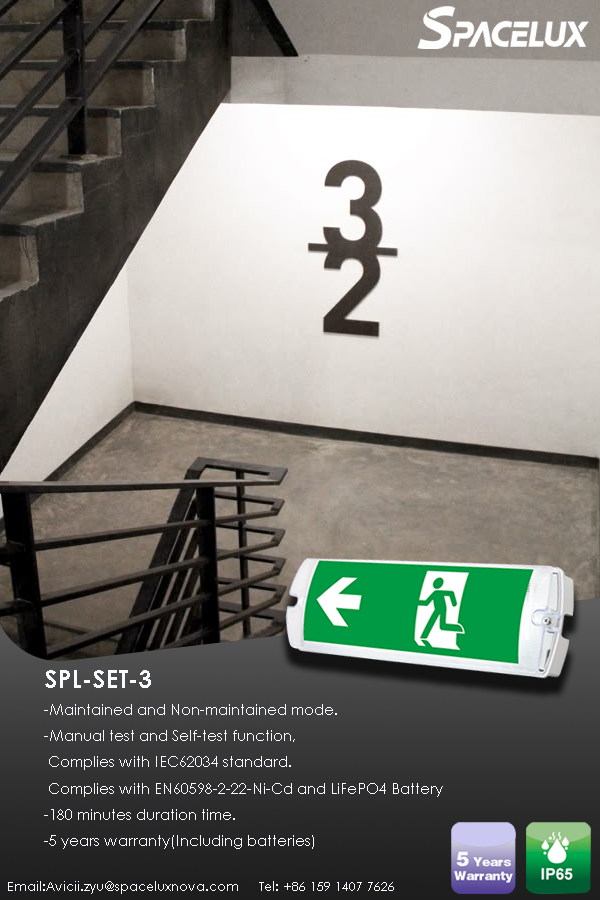
An emergency bulkhead light is a compact, surface-mounted luminaire designed to provide illumination along escape routes, at exit points, and in critical areas when the main power supply fails. Unlike general-purpose emergency lights that hang from ceilings or recess into panels, bulkhead units mount directly onto walls or ceilings with a low profile — typically under 100mm depth — making them ideal for corridors, stairwells, and spaces with limited mounting clearance.
The “bulkhead” name comes from the maritime world, where these robust fixtures were originally fitted to the bulkheads (vertical partition walls) of ships. Their design brief was simple: survive harsh conditions and stay lit when everything else goes dark. That DNA carries through to today’s commercial emergency bulkhead lights, which are built to withstand dust, moisture, and impact while delivering reliable emergency illumination.
How does an emergency bulkhead light differ from a standard emergency light? The core function is the same — both provide battery-backed illumination during power outages. The differences lie in form factor and application:
| Feature | Emergency Bulkhead Light | Standard Emergency Light |
|---|---|---|
| Mounting | Surface-mounted (wall/ceiling) | Recessed, suspended, or surface |
| Profile | Low-profile, compact | Varies; often larger |
| Durability | Typically IP65+ rated | Varies; some only IP20 |
| Best For | Corridors, stairwells, industrial | Open-plan offices, retail |
| Aesthetics | Functional, utilitarian | Can be more decorative |
For commercial buildings where compliance and reliability matter more than design flair, SpaceLux’s LED emergency lighting range offers bulkhead units that are both practical and cost-effective. Want to explore options for your building? Browse the SpaceLux emergency bulkhead range →
Maintained vs Non-Maintained: Which Type Do You Need?
This is the call that matters most. Get it wrong and you’ll either fail your audit or overspend — possibly both.
Maintained Emergency Bulkhead Lights
A maintained emergency bulkhead light operates like a normal light fitting during everyday use — it’s switched on and off with the rest of the lighting circuit. When mains power fails, the internal battery takes over seamlessly, keeping the same lamp illuminated without interruption.
This dual-function design makes maintained units the go-to choice for:
- Escape routes that are normally lit — corridors, stairwells, and hallways where the emergency light doubles as the everyday light source
- Public venues — theatres, cinemas, and places of worship where lights may be dimmed but exit paths must remain visible at all times
- Mixed-use spaces — where you want to avoid the “dark spot” problem of having unlit fixtures on the wall during normal operation
The key advantage: there’s no visual dead spot. Occupants are already familiar with the light’s location because they see it every day.
Non-Maintained Emergency Bulkhead Lights
A non-maintained emergency bulkhead light stays off during normal operation. It only activates when the mains supply fails and the battery backup kicks in. A small LED indicator shows the unit is receiving charge, but the main lamp remains dark until an emergency.
Non-maintained units are suited for:
- Areas with adequate general lighting — where the emergency fixture doesn’t need to contribute to everyday illumination
- Storage rooms and plant areas — where lights are only on when occupied
- Cost-sensitive projects — non-maintained units are typically 15-25% cheaper than equivalent maintained models
The trade-off: since the lamp isn’t in daily use, you won’t notice if the unit has failed until you test it or an actual emergency occurs. This makes rigorous monthly testing even more critical.
How to Choose Between Them
Ask yourself one question: Does this area need illumination during normal building operation?
- Yes → Maintained emergency bulkhead light
- No → Non-maintained emergency bulkhead light
- Unsure → Go maintained. It’s the safer choice, and many fire officers now expect maintained operation on designated escape routes.
Pro Tip: Some LED emergency bulkhead lights offer a “switchable” mode — they can be configured as either maintained or non-maintained at installation. This gives you flexibility if building use changes later. The SpaceLux series, for example, ships with maintained/non-maintained switching as standard.
Key Emergency Bulkhead Light Specifications That Actually Matter
Spec sheets throw a lot of numbers at you. Most of them you can ignore. You can’t do these.
Lumen Output & Duration
Two numbers define whether an emergency light does its job: brightness and duration.
- Lumen output: For escape routes, EN 1838 requires a minimum of 1 lux on the floor along the centre line of the escape route. A typical LED emergency bulkhead light delivers 120-360 lumens in emergency mode — enough to cover a 10-15 metre corridor section when positioned correctly. More lumens aren’t always better; it’s about distribution and placement.
- Duration: UK and EU standards require a minimum of 3 hours of emergency operation. US codes (NFPA 101) require 90 minutes minimum. Always specify 3-hour duration for UK/EU projects — it’s non-negotiable.
Watch out for “initial lumens” vs “end-of-discharge lumens.” The lumen figure at the start of the emergency period will be higher than at the 3-hour mark. Reputable manufacturers quote both.
IP Rating (Why IP65 Matters)
The IP (Ingress Protection) rating tells you how well the fixture resists dust and water. For emergency bulkhead lights, this is not optional — it’s a functional and regulatory requirement. Understanding the IP rating for emergency lighting is essential — here’s the short version, with our full IP rating breakdown available separately.
| IP Rating | Dust Protection | Water Protection | Typical Application |
|---|---|---|---|
| IP54 | Limited dust ingress | Splashing water | Indoor, clean areas |
| IP65 | Dust-tight | Water jets | Standard commercial |
| IP66 | Dust-tight | Powerful water jets | Industrial, outdoor, wash-down |
| IP67 | Dust-tight | Temporary immersion | Extreme environments |
An IP65 emergency bulkhead light is the baseline for most commercial installations. It’s dust-tight (no debris accumulating on the lens or battery compartment) and protected against water jets (pipe bursts, sprinkler discharge, or cleaning). For car parks, industrial plants, and exterior escape routes, step up to IP66.
If a supplier can’t confirm the IP rating, that’s a red flag — and a sign to find another supplier.
Battery Technology (NiCd vs Li-ion)
The battery is the heart of any emergency bulkhead light — and the most expensive component to replace. Here’s how the main technologies compare:
| Specification | NiCd | LiFePO4 / Li-ion |
|---|---|---|
| Lifespan | 3-4 years | 8-10 years |
| Cycle life | ~500 cycles | 2,000+ cycles |
| Memory effect | Yes — reduces capacity if not fully discharged | None |
| Energy density | Low | High |
| Charge time | 24-48 hours to full | 4-8 hours to full |
| Operating temperature | -40°C to +60°C | -20°C to +55°C (with BMS) |
| Environmental | Contains toxic cadmium (EU Battery Directive restricted) | No heavy metals |
| Replacement cost | £15-30 per unit | £25-50 per unit |
| Upfront cost | Lower | Higher (10-20% more) |
The real cost math: NiCd batteries are cheaper upfront but cost significantly more over the product lifecycle. You’ll replace a NiCd battery 2-3 times during the lifespan of a single LiFePO4/Li-ion pack. For a building with 50 emergency bulkhead lights, that’s the difference between 50 battery replacements and 150 over 10 years — plus the labour cost for each swap.
LiFePO4 batteries also support intelligent self-testing, which reduces the manual testing burden and provides automated compliance records. This alone can justify the price premium for facilities teams managing large portfolios.
⚠️ Important: You cannot directly swap a NiCd battery for a LiFePO4 battery in the same fixture. The voltage curves and charging requirements are different. If you’re upgrading, you need to replace the entire emergency module or the complete luminaire. For step-by-step instructions on emergency bulkhead light battery replacement, including compatible models and safety precautions, see our dedicated guide.
Mounting Options
Most commercial emergency bulkhead lights offer flexible mounting:
- Wall-mounted (most common) — ideal for corridors and stairwells
- Ceiling-mounted — for open areas and escape route junctions
- End-mounted — for narrow corridors or confined spaces
Look for fixtures with an adjustable or asymmetrical lens that lets you direct the light output. This is particularly useful for wall-mounted units where you need to throw light down the corridor rather than straight out from the wall.
Emergency Bulkhead Light Regulations You Can’t Ignore
Non-compliance with emergency lighting regulations isn’t a paperwork issue — it’s a legal liability. And the penalties have gotten dramatically harsher. Three regions, three sets of rules. Here’s how they compare — and where they’ll catch you out.
UK — BS 5266-1
BS 5266-1:2025 at a glance: Emergency bulkhead lights on escape routes must deliver at least 1 lux across the full width of the route for a minimum of 3 hours. Monthly functional tests (30 seconds) and annual full-duration tests (3 hours) are mandatory. Non-compliance carries unlimited fines under the Building Safety Act 2022.
BS 5266-1 is the UK code of practice for emergency lighting of premises. The 2025 edition (BS 5266-1:2025, published October 2025) introduces significant changes that every building owner and facilities manager must understand:
Key changes in BS 5266-1:2025:
- Expanded scope: The standard now covers three distinct categories — emergency escape lighting, local area lighting (new — for safe shutdown of hazardous processes before evacuation), and standby lighting (new — for continued operations during power loss)
- Full-width illumination: Escape routes must now meet illuminance requirements across their full width, not just along the centre line. This aligns with BS EN 1838:2024 and has major implications for fixture spacing and lumen output calculations
- Photometric verification: Compliance must be proven through measurement, not assumed. Initial verification and periodic re-verification are now expected
- Circuit resilience: Enhanced requirements to prevent single-point failures from knocking out large sections of emergency lighting, particularly in high-risk buildings
- Documentation: Stricter record-keeping expectations — design intent, testing regimes, verification results, and corrective actions must all be documented
Illuminance requirements (aligned with EN 1838):
- Escape routes: 1 lux minimum on the floor
- Open/anti-panic areas: 0.5 lux minimum on the floor
- High-risk task areas: Sufficient for safe task shutdown
- Fire alarm call points: 5 lux vertical illuminance
Duration: 3 hours minimum for emergency operation.
Testing: Monthly functional test (30 seconds minimum) + annual full-duration test (3 hours).
Penalties: Under the Building Safety Act 2022, breaches of building regulations — including emergency lighting non-compliance — carry an unlimited fine and/or up to 2 years’ imprisonment. The previous maximum fine was £5,000. This is not a theoretical risk — enforcement is increasing. The full standard is available from BSI Knowledge.
In 2023, a facilities management company in Manchester was fined £18,000 plus costs after a fire inspection revealed that 23 of 47 emergency bulkhead lights in a residential block had dead batteries and no testing records existed. The responsible person had assumed the lights “worked when installed” and never scheduled monthly checks. The court noted that the building’s 120 residents had been at “serious risk” for over a year.
EU — EN 1838 / EN 50172
EN 1838 (recently updated to BS EN 1838:2024) is the European product and performance standard for emergency lighting. EN 50172 covers the application and testing of emergency escape lighting systems.
Key requirements under EN 1838:
| Parameter | Requirement |
|---|---|
| Escape route illuminance | ≥ 1 lux (floor, centre line) |
| Anti-panic area illuminance | ≥ 0.5 lux (floor, excluding 0.5m perimeter) |
| High-risk area | 10% of normal illuminance or 15 lux, whichever is greater |
| Duration | ≥ 1 hour (3 hours recommended for most building types) |
| Response time | Full output within 60 seconds; 50% within 5 seconds |
| Colour rendering | CRI ≥ 40 for escape lighting |
| Redundancy | Two independent light sources per section of escape route |
EN 50172 requires documented monthly and annual testing, with records retained for the building’s lifetime. Many EU member states mandate a 3-hour duration as a national requirement (e.g., Germany under DIN EN 1838 + national annex).
US — NFPA 101 (Life Safety Code)
NFPA 101, also known as the Life Safety Code, governs emergency lighting in the United States. It works alongside the International Building Code (IBC) and National Electrical Code (NEC Article 700).
Key requirements:
| Parameter | NFPA 101 / IBC Requirement |
|---|---|
| Escape route illuminance | ≥ 1 foot-candle (10.76 lux) initially; ≥ 0.6 FC (6.46 lux) at 90 minutes |
| Exit sign illumination | Within 10 seconds of a power failure |
| Duration | ≥ 90 minutes |
| Switchover time | Within 10 seconds of power failure |
| Monthly test | 30 seconds minimum |
| Annual test | Full 90-minute discharge |
| Product standard | UL 924 listing required |
The full standard and latest amendments are available from NFPA.
Quick Comparison Table
| Requirement | UK (BS 5266-1) | EU (EN 1838) | US (NFPA 101) |
|---|---|---|---|
| Min. illuminance (escape) | 1 lux | 1 lux | 10.76 lux (1 FC) |
| Min. duration | 3 hours | 1-3 hours | 90 minutes |
| Monthly test | Yes (30s) | Yes | Yes (30s) |
| Annual test | Yes (3h) | Yes | Yes (90 min) |
| Max. switchover | Immediate | 5s (50%) / 60s (100%) | 10 seconds |
| Max. penalty | Unlimited fine + 2 years | Varies by country | Varies by jurisdiction |
Pro Tip: If you’re managing buildings across multiple regions, always design to the strictest standard. A 3-hour duration and 1 lux minimum will satisfy UK and EU requirements and exceed the US minimum — giving you a universal specification.
How to Choose the Right Emergency Bulkhead Light [Decision Framework]
Regulations tell you what’s required. But they don’t tell you which specific fixture to buy for your building. This decision framework does.
By Building Type
| Building Type | Recommended Type | IP Rating | Key Considerations |
|---|---|---|---|
| Office (corridors/stairs) | Maintained LED | IP65 | Switchable maintained/non-maintained for flexibility |
| Retail (shop floor) | Non-maintained LED | IP65 | Ensure high lumen output for large open areas |
| Hotel (corridors) | Maintained LED | IP65 | Aesthetic considerations; low-glare lens options |
| Industrial / Warehouse | Non-maintained LED | IP66 | Impact resistance; high temperature tolerance |
| Car park (underground) | Maintained LED | IP66 | Vandal resistance; corrosion-proof housing |
| Hospital (corridors/wards) | Maintained LED | IP65 | BS 5266-1:2025 local area lighting for medical equipment |
| School / University | Maintained LED | IP65 | Tamper-resistant; energy-efficient for large estates |
| Residential (communal areas) | Maintained LED | IP65 | Part of landlord duty of care; tenant-friendly design |
For project-specific commercial emergency lighting solutions, SpaceLux provides free specification support and site surveys.
By Environment
- Dry, clean indoor spaces (offices, hotels): IP65, standard polycarbonate housing
- Dusty or humid environments (warehouses, kitchens): IP65 minimum; IP66 preferred; choose fixtures with sealed battery compartments
- Outdoor or wash-down areas (car parks, food processing): IP66 essential; stainless steel or anti-corrosion housing
- Extreme temperatures (cold stores, foundries): Check operating temperature range; NiCd batteries perform better below -20°C; LiFePO4 needs thermal management
By Budget
Budget approach — initial cost focus:
- Non-maintained NiCd units from a reputable manufacturer
- IP65 rated (don’t compromise below this)
- Expect to replace batteries every 3-4 years
- Higher long-term maintenance costs
Value approach — total cost focus:
- Maintained LiFePO4/Li-ion units with intelligent self-testing
- IP66 rated for future-proofing
- Battery replacement every 8-10 years
- Self-test features reduce manual testing labour by up to 80%
- Lower total cost over a 10-year period
The math is clear: A LiFePO4-equipped LED emergency bulkhead light that costs £45 upfront will typically have a 10-year TCO of around £70-90 (including battery replacement and minimal manual testing). An equivalent NiCd unit at £30 upfront will cost £110-140 over the same period when you factor in 2-3 battery replacements and regular manual testing labour.
Ready to see the numbers for your building? Use the SpaceLux TCO calculator →
Total Cost of Ownership: The Number Nobody Shows You
Unit price is what most buyers look at. It’s also the wrong number to watch. The true cost of an emergency bulkhead light extends far beyond the purchase price — and the hidden costs can exceed the upfront price by 2-3× over a decade.
Here’s a realistic TCO breakdown for a single emergency bulkhead light over 10 years:
Cost Component Analysis
| Cost Component | NiCd Unit (£) | LiFePO4 Unit (£) | Notes |
|---|---|---|---|
| Purchase price | 25-35 | 40-55 | LiFePO4 commands 40-60% premium |
| Installation | 20-40 | 20-40 | Same for both; electrician rates vary |
| Monthly testing (labour) | 150-200 | 30-50 | LiFePO4 units with auto self-test reduce this dramatically |
| Annual full-duration test | 50-80 | 50-80 | Required regardless of battery type |
| Battery replacement #1 | 25-35 (yr 3-4) | — | NiCd needs first replacement |
| Battery replacement #2 | 25-35 (yr 6-8) | — | NiCd needs second replacement |
| Battery replacement (LiFePO4) | — | 25-50 (yr 8-10) | Single replacement at end of life |
| Battery replacement labour | 60-90 (×2) | 30-45 (×1) | £30-45 per swap; NiCd needs 2 swaps |
| Emergency bulkhead light battery replacement | Total: 110-160 | Total: 55-95 | Cumulative battery + labour |
| Compliance documentation | 20-40 | 10-20 | Auto self-test generates records automatically |
| Total 10-Year TCO | £460-680 | £315-490 | LiFePO4 saves 20-30% over 10 years |
Now multiply that by the number of fixtures in your building. A medium-sized office building with 80 emergency bulkhead lights faces a 10-year TCO difference of £11,600-£15,200 between NiCd and LiFePO4 options. The cheaper unit is actually the more expensive choice.
The Hidden Cost of Non-Compliance
TCO assumes compliance. Non-compliance adds an entirely different cost layer:
- Failed fire inspection → mandatory remediation order + re-inspection fee
- Insurance claim denied → if emergency lighting is non-functional during an incident, your insurer may refuse the claim
- Building Safety Act 2022 penalty → unlimited fine (previously capped at £5,000) + potential imprisonment. According to the ICEL Emergency Lighting Guide, the Act imposes unlimited fines and up to 2 years’ imprisonment
- Reputational damage → particularly for landlords and property managers
In the Manchester case mentioned earlier, the £18,000 fine was just the beginning. The building owner also faced £35,000 in remediation costs (emergency battery replacements, new fixtures, and expedited installation), increased insurance premiums, and 6 months of vacant possession while the work was completed. The total cost of non-compliance exceeded £70,000 — for a building where the compliance work would have cost roughly £4,000 if done proactively.
Emergency Bulkhead Light Installation & Wiring Best Practices
A great fixture, badly installed, is just an expensive liability. Here’s how to avoid the common traps.
Standard Wiring Arrangements
Emergency bulkhead lights require both a permanent live supply (to keep the battery charged) and a switched live connection (for maintained operation). The key wiring principles:
- Permanent live (unswitched): This must be connected to maintain battery charge regardless of whether the normal lighting circuit is on or off. Losing this supply means the battery won’t charge — and the unit won’t work when needed.
- Switched live: For maintained operation, connect to the lighting circuit switch. When the switch is off, the lamp operates on battery. For non-maintained operation, this connection is typically omitted or linked.
- Earth: Always connect the earth terminal. This is a safety requirement, not optional.
- Fire-rated cable: On escape routes, use fire-rated cable (e.g., FP200, FP400) that maintains circuit integrity under fire conditions for the required duration.
Common Installation Mistakes
| Mistake | Consequence | Fix |
|---|---|---|
| Connecting switched live to permanent live | Maintained light won’t switch off; battery may not charge correctly | Verify wiring against the manufacturer’s diagram before powering up |
| Omitting the earth connection | Safety hazard; fails inspection | Always connect earth — no exceptions |
| Using non-fire-rated cable on escape routes | Circuit fails in fire; non-compliant with BS 5266-1:2025 | Specify fire-rated cable for all emergency circuits on escape routes |
| Incorrect spacing between fixtures | Not configuring the maintained/non-maintained mode | Use photometric calculations to determine spacing; don’t estimate |
| Mounting too high or too low | Reduced effectiveness; may not meet lux requirements at floor level | Wall-mount at 2m+ above floor; ceiling-mount per manufacturer’s guidance |
| Installing in locations with high ambient light | Light operates in the wrong mode; may fail compliance | Position indicator LED where it can be seen during monthly checks |
| Position indicator LED that can be seen during monthly checks | Dark spots on escape routes; fail illuminance requirements | Set the mode at installation and document it |
Field note: After installation, perform a night-time walk-through — kill the main power and walk every escape route in darkness. This is the only reliable way to identify dark spots, shadowed areas, and units that fail to activate. Document the results with photographs.
Troubleshooting Common Issues
No fixture lasts forever. Here are the six faults you’re most likely to see — and how to fix them.
1. Light Fails to Activate During Power Failure
Likely cause: Dead or degraded battery; faulty charging circuit; disconnected permanent live supply.
Fix: Check the indicator LED — if it’s off, the unit isn’t receiving charge. Verify the permanent live connection. Test the battery voltage; if it’s below the rated threshold after a full charge cycle, replace the battery. For NiCd batteries, this typically occurs after 3-4 years; for LiFePO4, after 8-10 years.
2. Indicator LED Is Off
Likely cause: No mains supply to the unit; blown fuse or tripped circuit; faulty charge indicator.
Fix: Check the circuit breaker and fuses for the permanent live supply. If power is reaching the unit but the LED is still off, the internal charge circuit may have failed — replace the unit.
3. Light Stays On Permanently (Non-Maintained Mode)
Likely cause: Wiring error (switched live connected to permanent live); faulty changeover relay; unit incorrectly set to maintained mode.
Fix: Check the wiring configuration against the manufacturer’s diagram. Verify that the maintained/non-maintained switch or jumper is set correctly. If wiring is correct, the changeover relay may be stuck — replace the unit.
4. Flickering or Intermittent Operation
Likely cause: Loose wiring connection; failing battery; voltage drop on long cable runs; faulty LED driver.
Fix: Inspect all terminal connections for tightness. Check for voltage drop (especially on long cable runs to remote fixtures). If the battery is near the end of its life, replace it. If connections and battery are sound, the LED driver is likely failing — replace the entire unit.
5. Reduced Duration (Doesn’t Last 3 Hours)
Likely cause: Battery capacity degradation; battery not fully charged; emergency bulkhead light battery replacement overdue.
Fix: Ensure the unit has been on charge for at least 24-48 hours (NiCd) or 8 hours (LiFePO4) before testing. If duration is still below spec, the battery has reached end-of-life — replace it. This is the single most common reason for annual test failures.
6. Unit Activates Randomly or Intermittently
Likely cause: Voltage fluctuations on the mains supply; faulty changeover sensor; electrical interference from nearby equipment.
Fix: Monitor the mains supply voltage — significant dips can trigger the changeover circuit. If the voltage is stable, the sensor may be overly sensitive or faulty. Check for interference sources (large motors, welding equipment) on the same circuit. If the issue persists, replace the unit with one that has better voltage threshold management.
| Symptom | Quick Check | Most Likely Fix |
|---|---|---|
| Won’t activate | Indicator LED status | Check supply; replace if the charge circuit failed |
| LED indicator off | Circuit breaker | Check supply; replace if charge circuit failed |
| Stays on permanently | Wiring configuration | Correct wiring or mode setting |
| Flickering | Terminal connections | Tighten connections; check voltage drop |
| Short duration | Charge time & battery age | Replace battery |
| Random activation | Mains voltage | Check supply stability; replace sensor |
SPACELUX Emergency Bulkhead Light Series
If you’ve made it this far, you know what separates a compliant, reliable emergency bulkhead light from a liability. SpaceLux designed its emergency bulkhead series around exactly these pain points. We specified IP66 across the entire range because we’ve seen too many IP65 units fail in car parks and plant rooms — the extra protection costs us nothing to include, and it costs you nothing extra either.
Key specifications across the SpaceLux range:
| Feature | SpaceLux Standard | SpaceLux Pro |
|---|---|---|
| IP Rating | IP66 | IP66 |
| Battery Technology | LiFePO4 | LiFePO4 |
| Emergency Duration | 3 hours | 3 hours |
| Lumen Output (emergency) | 180 lm | 360 lm |
| Maintained/Non-Maintained | Switchable | Switchable |
| Self-Test | Automatic | Automatic + remote monitoring |
| Operating Temperature | -20°C to +55°C | -20°C to +55°C |
| Housing | Flame-retardant polycarbonate | Anti-vandal polycarbonate |
| Warranty | 3 years | 3 years |
What sets SpaceLux apart from the competition:
- IP66 as standard, not IP65 — the extra protection against powerful water jets costs you nothing extra but adds a meaningful safety margin for car parks, plant rooms, and exterior routes
- LiFePO4 battery technology with 8-10 year lifespan — eliminating 2-3 battery replacement cycles compared to NiCd alternatives
- Intelligent self-testing that automatically performs monthly functional tests and annual duration tests, generating compliance records you can present to any fire officer
- Switchable maintained/non-maintained — configure at installation, reconfigure if building use changes
- 3-year warranty — one of the longest in the commercial emergency bulkhead category
The SpaceLux Pro adds remote monitoring capability, allowing facilities teams to check the status of every emergency bulkhead light across multiple buildings from a single dashboard — no more walking corridors with a clipboard.
Explore the full SpaceLux emergency bulkhead range and request a quote → www.spaceluxnova.com
Frequently Asked Questions
How often should emergency bulkhead lights be tested?
Emergency lighting bulkhead units require a monthly functional test (simulate power failure for 30 seconds and verify illumination) and an annual full-duration test (3-hour discharge to confirm battery capacity). BS 5266-1, EN 50172, and NFPA 101 all mandate both. Self-testing units automate the monthly test but still require an annual physical inspection.
What is the difference between maintained and non-maintained emergency bulkhead lights?
A maintained emergency bulkhead light operates as a normal light during everyday use and switches to battery power when mains fails — it’s always illuminated. A non-maintained emergency bulkhead light stays off during normal operation and only activates during a power failure. Maintained units are required on escape routes where the public may be present; non-maintained units are suitable for areas with adequate general lighting.
What IP rating do I need for a commercial emergency bulkhead light?
IP65 is the minimum for most commercial applications — it provides complete dust protection and resistance to water jets. For outdoor areas, car parks, industrial environments, and wash-down zones, IP66 is recommended for its higher water jet protection. The SpaceLux range offers IP66 across all models as standard.
How long does an emergency bulkhead light battery last?
NiCd batteries typically last 3-4 years before requiring replacement. LiFePO4/Li-ion batteries last 8-10 years. However, the emergency bulkhead light battery replacement schedule should be driven by annual duration test results — if a unit fails to deliver its rated 3-hour duration, the battery needs replacement regardless of age.
Can I replace a NiCd battery with a Li-ion battery in the same fixture?
No. NiCd and LiFePO4/Li-ion batteries have different voltage curves, charging requirements, and thermal profiles. You cannot swap one for the other in the same emergency module. To upgrade, you need to replace the entire emergency module or the complete luminaire.
What are the penalties for non-compliant emergency lighting?
In the UK, the Building Safety Act 2022 increased the maximum penalty for building regulation breaches to an unlimited fine and/or up to 2 years’ imprisonment (previously capped at £5,000). Additionally, non-compliance can invalidate insurance claims and result in enforcement orders that require costly remediation within tight deadlines.
Conclusion
Getting this right isn’t hard. Getting it wrong is expensive — sometimes dangerously so. The wrong choice means failed inspections, avoidable costs, and potentially dangerous gaps in your building’s life safety systems. The right choice means a decade of reliable compliance with minimal maintenance overhead.
Here’s what to take away:
- Specify maintained or non-maintained based on building use — default to maintained for any escape route
- Don’t compromise on IP65 — and choose IP66 for demanding environments
- LiFePO4 batteries cost more upfront but save 20-30% over 10 years — the TCO advantage is clear
- BS 5266-1:2025 has raised the bar — full-width illumination, photometric verification, and stricter documentation are now required
- Non-compliance penalties are unlimited — the Building Safety Act 2022 eliminated the £5,000 cap
- Total cost of ownership matters more than unit price — factor in batteries, testing labour, and compliance documentation
Your next step: audit your current emergency lighting installation against the requirements in this guide. If you find gaps — and most buildings do — the SpaceLux emergency bulkhead series offers an IP66, LiFePO4-equipped, self-testing solution that’s built to exceed current standards.
Start your upgrade with SPACELUX →
When the power fails, those fixtures on the wall are the last thing between your occupants and a safe exit. Make sure they work.


