
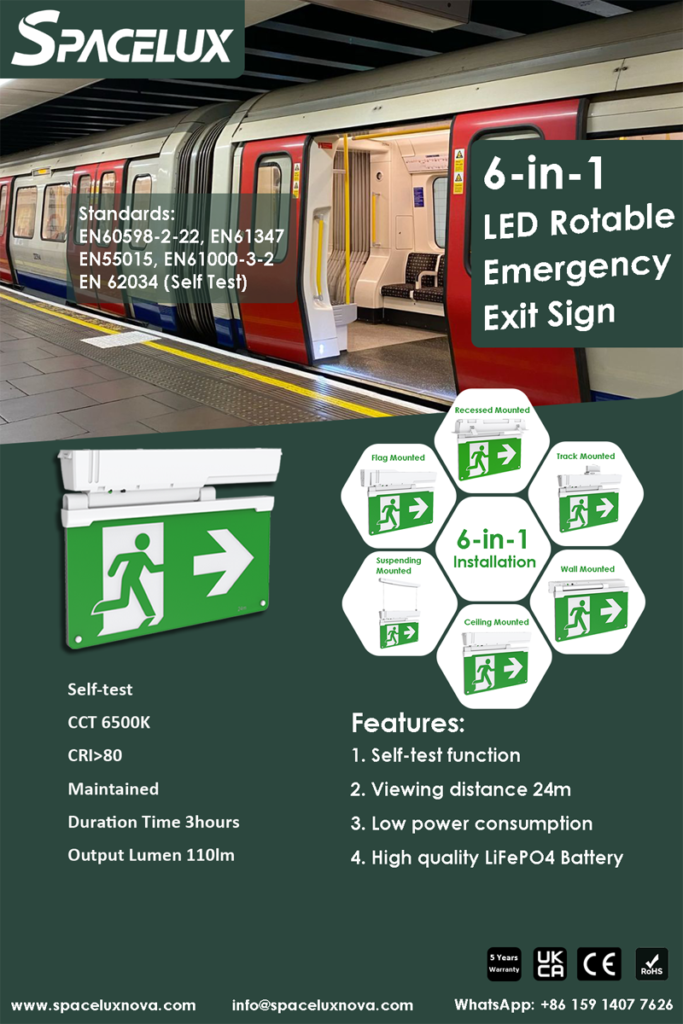
Most emergency exit sign tenders still list six separate SKUs: wall, ceiling, recessed, flag, track, and suspended. A 6-in-1 rotatable LED exit sign collapses all six into a single part number, a single EN 60598-2-22 certificate, and a single LiFePO4 battery that lasts 6–8 years and operates from −20°C to +60°C. This guide explains the procurement, compliance, and total-cost-of-ownership math behind that decision — for UK, EU, UAE, Saudi Arabia, Qatar, and wider GCC projects, including Civil Defense and SBC 801 compliance, high-temperature performance, and where the new EN 62034 self-test requirement is changing what buyers should be specifying in 2026.
Contents
- What is a 6-in-1 rotatable emergency exit sign?
- The procurement case: one SKU, six mounting methods
- Middle East & GCC: one SKU for mega-project scale
- The compliance case: EN 60598-2-22, EN 62034 and friends
- Middle East compliance: Civil Defense, SBC 801, SASO & ESMA
- Why the battery is now the deal-breaker: LiFePO4 vs Ni-Cd
- Total cost of ownership over 10 years
- Middle East TCO: UAE, Saudi Arabia & Qatar project math
- What to specify on your next tender
- How to install all six mounting methods
- FAQ
1. What is a 6-in-1 rotatable emergency exit sign?
A 6-in-1 emergency exit sign is a single LED luminaire designed to be installed in any one of six different positions, using the brackets supplied in the box:
- Wall mounted — flat against a vertical surface
- Ceiling mounted — surface-mounted on a horizontal soffit
- Recessed mounted — set into a plaster or ceiling tile cut-out
- Flag mounted — perpendicular projection from a wall
- Track mounted — clipped onto a lighting track (common in retail fit-outs)
- Suspended mounted — hanging from rods or wire for high-ceiling atria
The “rotatable” part refers to the pictogram plate: the green running-man legend is fixed to a plate that twists through 90° increments, so the arrow always points the right way regardless of which of the six mounting methods the contractor has chosen on site. That single mechanical detail — a freely rotating legend on a captive pivot — is what allows one SKU to replace six.
On a single building, this matters. A typical UK office block, hospital, or rail station will use all six mounting methods somewhere on site. Traditionally, the buyer carries six SKUs, six prices, six stock locations, and six replacement cycles. A 6-in-1 design reduces that to one.
2. The procurement case: one SKU, six mounting methods
Walk into a tender pre-meeting on a UK commercial project and the lighting schedule will frequently look like this:
| Code | Description | Qty | Unit price | Line total |
|---|---|---|---|---|
| EX-W | Exit sign, wall mounted, maintained, 3hr | 120 | £28 | £3,360 |
| EX-C | Exit sign, ceiling mounted, maintained, 3hr | 85 | £30 | £2,550 |
| EX-R | Exit sign, recessed, maintained, 3hr | 40 | £42 | £1,680 |
| EX-F | Exit sign, flag, maintained, 3hr | 30 | £34 | £1,020 |
| EX-T | Exit sign, track mounted, maintained, 3hr | 15 | £36 | £540 |
| EX-S | Exit sign, suspended, maintained, 3hr | 10 | £38 | £380 |
| Total (6 SKUs) | £9,530 | |||
Now consolidate to a single 6-in-1 rotatable SKU at a typical mid-tier project price of £30 per unit:
| Code | Description | Qty | Unit price | Line total |
|---|---|---|---|---|
| EX-6IN1 | Exit sign, rotatable 6-in-1, maintained, 3hr | 300 | £30 | £9,000 |
| Total (1 SKU) | £9,000 | |||
The hardware saving looks modest (£530 on a 300-unit job). The real savings are downstream:
- Warehousing: 6 part numbers → 1 part number. Typical distributor carrying cost on emergency lighting inventory is 18–22% per SKU per year.
- Procurement admin: 6 POs, 6 supplier relationships, 6 lead-time negotiations → 1 of each.
- On-site error: contractor orders the wrong SKU, fix delayed, second delivery, markup. A 6-in-1 sign means the wrong mounting bracket is the worst-case error, not a wrong sign.
- Replacements over 10 years: a single replacement cycle covers the whole building, not six.
For a 500-unit mixed project, total procurement and warehouse carrying cost typically drops 35–50% when consolidating to a 6-in-1 SKU. That is the procurement case.
3. Middle East & GCC: one SKU for mega-project scale
The procurement case for a 6-in-1 exit sign becomes even more compelling on Middle East mega-projects, where a single development can call for 5,000–20,000 emergency exit signs across multiple buildings, phases, and mounting configurations.
Consider the scale of active GCC construction in 2026:
| Market | Representative mega-projects | Typical exit sign volume |
|---|---|---|
| Saudi Arabia | NEOM, The Line, Red Sea Project, Diriyah Gate, ROSHN, Qiddiya | 10,000–50,000+ units per project |
| UAE | Dubai South, Abu Dhabi Yas Bay, Sharjah Muwaileh, Expo City legacy | 3,000–15,000 units per development |
| Qatar | Lusail City, Msheireb Downtown, Education City expansion | 2,000–8,000 units per project |
| Kuwait | South Saad Al Abdullah City, Sabah Al Ahmad Sea City | 2,000–5,000 units per project |
| Oman | Oman Vision 2040 developments, Madinat Al Irfan | 1,000–3,000 units per project |
| Bahrain | Bahrain Bay, Diyar Al Muharraq | 1,000–2,000 units per project |
On a NEOM-scale project with 20,000 exit signs across mixed-use towers, residential blocks, transit hubs and subterranean corridors, the difference between managing six SKUs vs one is not a procurement convenience — it is a supply-chain necessity. The 6-in-1 design means:
- One purchase order covers the entire development, regardless of how many mounting methods the MEP consultant has scheduled across different buildings.
- One container load ships from Shenzhen to Jebel Ali (UAE), Jeddah Islamic Port or King Abdullah Port (KSA), or Hamad Port (Qatar) — no split shipments for different mounting types.
- One spare-parts list for the facilities management team post-handover. On a 20,000-sign development, that is the difference between a 6-line and a 1-line spare register.
- Consultant approval is sought once, not six times. MEP consultants at AECOM, WSP, Arup, Jacobs, Mott MacDonald and Buro Happold typically review and approve each exit sign SKU individually — one approval cycle is faster than six.
For MEP contractors and main contractors in the GCC — companies such as Drake & Scull, Khansaheb, Al-Futtaim Carillion, Nesma, Al-Bawani, Almabani, and HBK Contracting — the 6-in-1 design also eliminates the most common site error: the wrong mounting type delivered to the wrong floor. Because the bracket is field-selectable, the contractor carries one sign body and fits the bracket on site to match the actual mounting condition.
“On a 10,000-unit Saudi giga-project, consolidating from 6 SKUs to 1 saves an estimated 200+ hours of procurement admin and eliminates the reorder cycle caused by wrong-mount deliveries.” — SPACELUX Engineering Team
4. The compliance case: EN 60598-2-22, EN 62034 and friends
A rotatable exit sign is mechanically clever but, on a UK or EU tender, it is only as good as the standard numbers on the declaration of conformity. Here is what each one means and why it matters in 2026.
| Standard | What it covers | Why it matters |
|---|---|---|
| EN 60598-2-22 | Luminaires for emergency lighting | The core product standard. No sign can be sold for emergency use in the EU/UK without this. |
| EN 61347 | Lamp controlgear safety | Covers the LED driver, charge circuit, and battery management. |
| EN 55015 | EMC emissions limits | Required to avoid interfering with fire alarm and BMS systems. |
| EN 61000-3-2 | Harmonic current limits | Required for any product connected to the public mains supply. |
| EN 62034 | Automatic test systems for emergency escape lighting | The one to watch: specifies self-test, battery duration test, and status indication. |
| BS 5499-4 | UK code of practice for escape route signing | Reference under BS 5266-8; sets viewing distance and legend format (24m class is common). |
The 2026 development to pay attention to is EN 62034. More UK and EU tenders are now requiring a self-test exit sign rather than a manually tested one. The reason is simple economics: BS 5266-8 mandates a monthly functional test and an annual 3-hour duration test, each of which typically costs a facilities team £8–£15 per fitting per year in dedicated test labour. On a 300-sign building, that is £2,400–£4,500 per year, every year, for the life of the building.
An EN 62034 self-test sign runs that schedule itself. A status LED (green = OK, red = fault) flags a failed fitting to the maintenance team, who only have to walk the building when there is a red light to investigate. On a 300-sign building the test labour saving is typically 80–90%, paying back the small premium on a self-test sign within 18–24 months.
“On any project above 200 emergency luminaires, the lifetime cost of a self-test exit sign is now lower than a manually tested one, even after the unit-price premium for EN 62034 compliance.” — SPACELUX Engineering Team
5. Middle East compliance: Civil Defense, SBC 801, SASO & ESMA
For projects in the UAE, Saudi Arabia, Qatar, Kuwait, Oman and Bahrain, emergency lighting must satisfy both the international EN/IEC standards and the local authority having jurisdiction (AHJ). Here is how the 6-in-1 exit sign maps to each Gulf market.
| Market | Authority / Code | What is required | How the 6-in-1 sign qualifies |
|---|---|---|---|
| UAE | UAE Civil Defense (Ministry of Interior); UAE Fire & Life Safety Code of Practice | Emergency lighting certified to recognized international standards; product must be registered or accepted by Civil Defense before installation. | EN 60598-2-22 + CE + RoHS documentation supplied in English & Arabic. SPACELUX provides full Civil Defense submission package. |
| Saudi Arabia | Saudi Civil Defense; SBC 801 (Fire Protection); SASO | SBC 801 requires emergency lighting per international standards. SASO Certificate of Conformity (SASO COC) needed for import via SABER platform. | EN 60598-2-22 + EN 62034 + IECEE CB Scheme test report. SPACELUX supports SABER registration and SASO COC issuance. |
| Qatar | Qatar Civil Defense; QCS 2014 (Qatar Construction Specifications) | Emergency lighting must meet EN/IEC or equivalent standards. Product registration with Civil Defense for projects above threshold. | Full EN/IEC compliance documentation. SPACELUX supplies Arabic datasheets and test reports for Qatar Civil Defense submission. |
| Kuwait | Kuwait Fire Force (KFF); Kuwait Code of Practice for Fire Safety | Imported emergency lighting must carry internationally recognized certification (CE/EN/IEC). | CE + EN 60598-2-22 + EN 62034. Documentation package in English & Arabic. |
| Oman | Royal Oman Police (Civil Defence); Omani Building Code | Emergency lighting per international standards; Civil Defence approval on project basis. | EN/IEC test reports and CE declaration supplied for Civil Defence review. |
| Bahrain | Bahrain Civil Defence; Bahrain National Building Code | Emergency lighting to recognized international standards. | CE + EN 60598-2-22 + EN 62034 documentation package. |
| GCC-wide | GSO (GCC Standardization Organization) | GSO technical regulations align with IEC standards for lighting products; GCC conformity marking where applicable. | IECEE CB Scheme report covers GSO alignment. SPACELUX provides GSO-compliant documentation. |
Arabic & bilingual legend requirements
Many GCC Civil Defense authorities require exit signs to display bilingual English/Arabic legends or Arabic-only legends, depending on the project type and jurisdiction. The 6-in-1 rotatable sign is available with:
- English-only legend (standard ISO 7010 running-man pictogram + “EXIT”)
- Arabic-only legend (“خروج” + running-man pictogram)
- Bilingual EN/AR legend (EXIT / خروج + running-man pictogram) — the most common specification on UAE and Saudi commercial projects
The rotatable pictogram plate is available in all three formats. For tender submissions, SPACELUX provides legend mock-ups in PDF for consultant approval before production.
Documentation package for Middle East projects
SPACELUX supplies the following documentation with every Middle East order, to support Civil Defense, SASO, consultant and main-contractor approval:
- EN 60598-2-22 type-test certificate (notified body)
- EN 62034 self-test compliance report
- EN 61347 / EN 55015 / EN 61000-3-2 test reports
- CE Declaration of Conformity (English & Arabic translated)
- RoHS compliance statement
- IECEE CB Scheme test report (for SASO / SABER registration)
- Product datasheet in English & Arabic
- Installation & maintenance manual (English & Arabic)
- Material safety datasheet for LiFePO4 battery
6. Why the battery is now the deal-breaker: LiFePO4 vs Ni-Cd
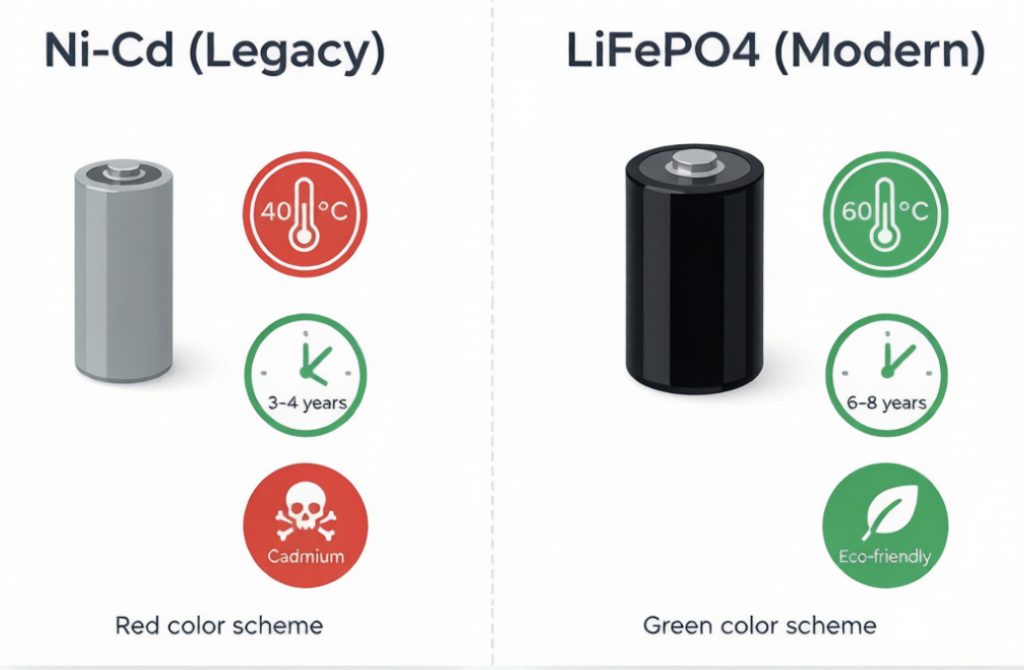
Every exit sign is only as good as its battery. The two chemistries you will see on a 2026 tender are Ni-Cd (nickel-cadmium) and LiFePO4 (lithium iron phosphate). They are not equivalent.
| Parameter | Ni-Cd (legacy) | LiFePO4 (modern) |
|---|---|---|
| Service life | 3–4 years | 6–8 years |
| Self-discharge / month | 15–20% | 2–3% |
| Cadmium content | Yes (heavy metal) | None |
| EU Battery Directive 2006/66/EC | Restricted, special disposal | Compliant |
| Operating temperature | 0°C to +40°C | −20°C to +60°C |
| Weight (typical 3.2V pack) | ~180g | ~110g |
| Suitable for EN 62034 self-test | Marginal (capacity loss) | Excellent (flat discharge curve) |
Two practical consequences for buyers:
- Total cost: a LiFePO4 sign is typically £3–£5 more expensive at the point of purchase, but the battery will not need to be replaced for 6–8 years instead of 3–4. Across a 10-year life, that single detail is worth roughly £6–£10 per fitting in avoided battery swaps and access charges.
- EN 62034 compatibility: the EN 62034 self-test measures the actual duration of the battery under load. Ni-Cd capacity degrades visibly in year 3, which is exactly when a self-test starts reporting failures. LiFePO4 holds its flat discharge curve across the full 6–8-year window, so self-test readings stay green for the entire service life.
- High-temperature performance (Middle East / GCC): this is critical for projects in the UAE, Saudi Arabia, Qatar, Kuwait, Oman and Bahrain, where ceiling voids and exit-sign enclosures routinely reach 45–55°C in summer. Ni-Cd batteries degrade accelerated above 40°C, losing 30–40% of capacity within 2 years in GCC conditions. LiFePO4 operates from −20°C to +60°C with a flat degradation curve, making it the only viable chemistry for Middle East emergency lighting that needs to pass EN 62034 self-test for the full service life.
7. Total cost of ownership over 10 years
Putting it all together for a typical 300-sign UK commercial fit-out:
| Cost line | Traditional (6 SKU, Ni-Cd, no self-test) | 6-in-1 (1 SKU, LiFePO4, EN 62034) |
|---|---|---|
| Hardware (300 units) | £9,530 | £9,000 |
| Procurement admin (setup) | £600 (6 POs, 6 suppliers) | £120 (1 PO, 1 supplier) |
| Battery replacements (10 yrs) | £7,200 (2 swaps × £12 × 300) | £0 (within service life) / £4,320 (1 swap at yr 7) |
| Manual test labour (10 yrs) | £30,000 (300 × £10/yr × 10) | £3,000 (response-only on red LED) |
| Warehouse carrying (10 yrs) | £4,000 (6 SKU carrying) | £700 (1 SKU carrying) |
| 10-year TCO | £51,330 | £17,140 (or £12,820 with 0 swaps) |
A 6-in-1 LiFePO4 self-test sign cuts the 10-year TCO by roughly 65–75%. This is the number to put in front of a project owner who only sees the unit price.
8. Middle East TCO: UAE, Saudi Arabia & Qatar project math
The TCO advantage is amplified on Middle East mega-projects, where exit sign volumes are typically 5–20x larger than a UK commercial fit-out and where high ambient temperatures accelerate Ni-Cd battery failure. Here is the same 10-year calculation, sized for a 3,000-unit GCC mixed-use development (comparable to a mid-scale tower cluster in Dubai Marina, Riyadh North, or Lusail City).
| Cost line (3,000 units) | Traditional (6 SKU, Ni-Cd, no self-test) | 6-in-1 (1 SKU, LiFePO4, EN 62034) |
|---|---|---|
| Hardware (3,000 units) | AED 390,000 (~$106,000) | AED 360,000 (~$98,000) |
| Procurement & customs (SABER / ESMA / Civil Defense documentation) | AED 45,000 (6 SKUs × 6 approval cycles) | AED 9,000 (1 SKU × 1 approval cycle) |
| Battery replacements (10 yrs, 50°C ambient) | AED 360,000 (3 swaps × AED 40 × 3,000; Ni-Cd fails every 2–3 yrs in GCC heat) | AED 0 (LiFePO4 rated to +60°C, 6–8 yr life) |
| Manual test labour (10 yrs) | AED 360,000 (3,000 × AED 12/yr × 10) | AED 36,000 (response-only on red LED) |
| Warehouse & spare-parts carrying (10 yrs) | AED 90,000 (6 SKU inventory) | AED 18,000 (1 SKU inventory) |
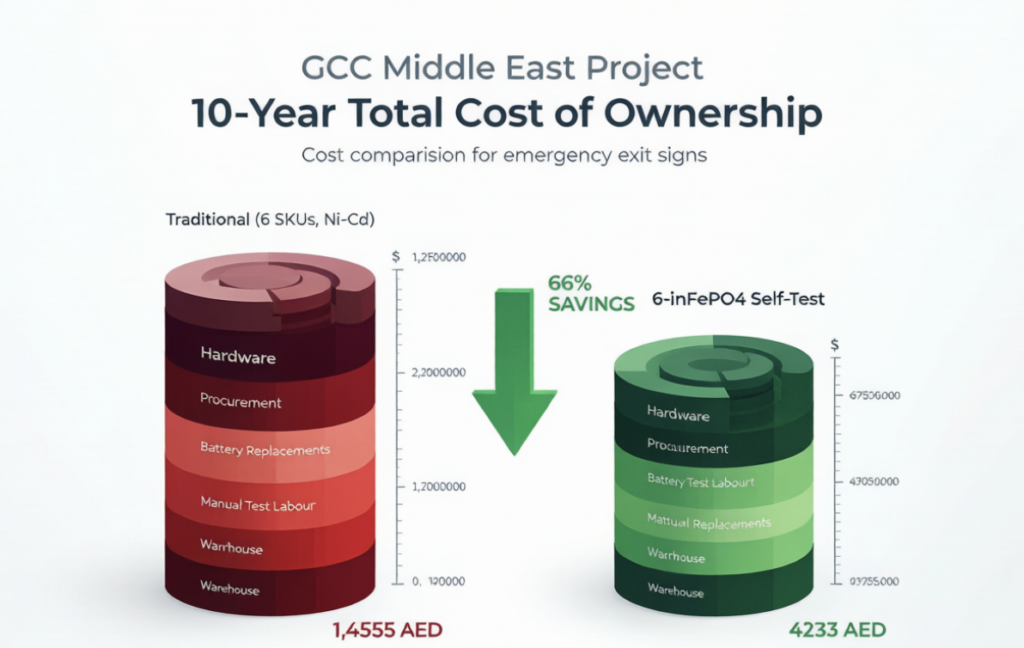
| 10-year TCO (AED) | AED 1,245,000 | AED 423,000 |
| 10-year TCO (USD approx.) | ~$339,000 | ~$115,000 |
On a 3,000-unit Middle East project, the 6-in-1 LiFePO4 self-test design saves approximately AED 822,000 (~$224,000) over 10 years — a 66% TCO reduction. The savings are driven primarily by:
- Ni-Cd battery failure in GCC heat: at 50°C ambient, Ni-Cd batteries need replacement every 2–3 years (not 3–4 as in temperate climates). LiFePO4 is unaffected.
- Self-test eliminates manual testing: in the UAE and Saudi Arabia, facilities management labour rates are AED 40–80/hour. Manual testing of 3,000 signs monthly is a full-time job. EN 62034 self-test removes 90% of that cost.
- Single Civil Defense / SASO approval: each separate SKU requires its own documentation submission. One SKU = one approval cycle = faster project handover.
For Saudi giga-projects at 20,000+ units (NEOM, The Line, Red Sea Project), the 10-year TCO saving scales proportionally to AED 5.5M+ (~$1.5M+).
9. What to specify on your next tender
If you are writing or reviewing a UK/EU emergency lighting specification, the rotatable 6-in-1 design ticks the boxes below. Use this as your spec template.
- Mounting methods: wall, ceiling, recessed, flag, track, suspended — all in one SKU with rotatable legend
- Mode: maintained (illuminated both in mains and emergency mode)
- Emergency duration: minimum 3 hours to BS 5266-8
- Viewing distance: 24 m class (EU/UK standard for corridors, offices, retail)
- Battery: LiFePO4, 3.2V, ≥ 1500 mAh, 6-year minimum service life
- Self-test: EN 62034 compliant, with status LED
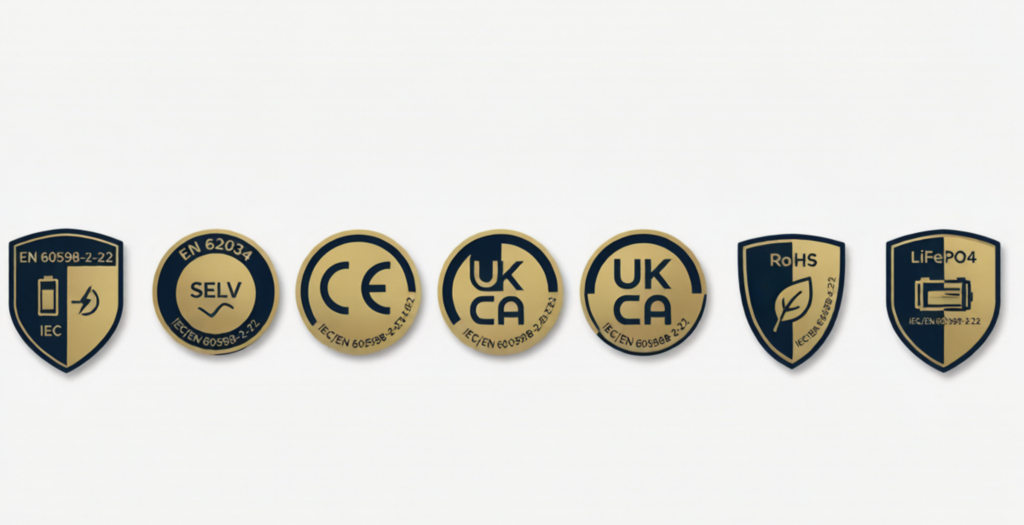
- Standards: EN 60598-2-22, EN 61347, EN 55015, EN 61000-3-2, EN 62034
- Approvals: CE, UKCA, RoHS
- CCT: 6500K (matches BS 5499-4 legend luminance contrast requirements)
- CRI: > 80
- Warranty: minimum 5 years on the luminaire and battery
- Operating temperature: −20°C to +60°C (essential for Middle East / GCC ambient conditions)
- Ingress protection: IP65 minimum (dust and moisture ingress protection for GCC environments)
- Legend language: English, Arabic, or bilingual EN/AR (per Civil Defense/project requirements)
- Middle East approvals: Civil Defense submission package (UAE/KSA/Qatar), SASO COC via SABER (Saudi Arabia), ESMA registration (UAE), IECEE CB Scheme test report
- Documentation language: English & Arabic datasheets, installation manuals, and declaration of conformity
10. How to install all six mounting methods
The 6-in-1 design is one luminaire, but it ships with six brackets. The installation sequence is the same for all six; only the bracket changes.
- Identify the mounting type from the lighting schedule. The same luminaire body fits all six.
- Select the matching bracket from the accessory pack: wall plate, ceiling plate, recessed spring clips, flag arm, track adapter, or suspension kit.
- Wire the mains supply to the terminal block (L / N / Earth). Isolate at the breaker before wiring.
- Rotate the legend to the correct orientation. The pictogram plate twists through 90° increments on a captive pivot.
- Apply mains power. The EN 62034 self-test will run a commissioning cycle within 24 hours; the status LED will go solid green.
Total installation time per fitting is typically 8–12 minutes once the bracket is selected. No reprogramming, no rewiring between mounting methods.
11. Frequently asked questions
What is a 6-in-1 emergency exit sign?
A 6-in-1 emergency exit sign is a single LED luminaire that can be installed in six different mounting methods — wall, ceiling, recessed, flag, track, and suspended — by swapping the included bracket and rotating the pictogram plate. It replaces what would otherwise be six separate SKUs on a tender.
Is a 6-in-1 exit sign compliant with UK and EU regulations?
When the luminaire is certified to EN 60598-2-22 (luminaires for emergency lighting), EN 61347 (lamp controlgear), EN 55015 (EMC emissions), EN 61000-3-2 (harmonic current) and EN 62034 (automatic test systems for emergency lighting), it is accepted under BS 5499-4 in the UK and the equivalent national standards across the EU.
Why does the battery type matter on an emergency exit sign?
Most legacy exit signs use Ni-Cd (nickel-cadmium) batteries, which lose capacity after 3–4 years, contain toxic heavy metals restricted under EU Battery Directive 2006/66/EC, and have a self-discharge rate of up to 20% per month. LiFePO4 (lithium iron phosphate) batteries last 6–8 years, have a 3% monthly self-discharge, and contain no cadmium, making them the preferred chemistry for tenders that demand EN 62034 self-test compliance and low total cost of ownership.
What does EN 62034 self-test actually do?
EN 62034 specifies automatic test systems for battery-powered emergency escape lighting. A self-test exit sign runs a short function test weekly and a full 3-hour duration test annually, flagging failures through a status LED. This eliminates the manual monthly and annual test walks required by BS 5266-8, which typically cost a UK facilities team £8–£15 per fitting per year in labour.
How does one rotatable SKU reduce project cost?
A traditional exit sign tender might list six separate SKUs — wall surface, ceiling surface, recessed, flag, track, and suspended. With a 6-in-1 rotatable sign, the buyer carries one part number, one price, one stock location, and one replacement cycle. On a 500-unit mixed project, procurement and warehouse carrying cost typically drops 35–50%.
Can a 6-in-1 exit sign be used on UK rail projects?
Yes. Stations, depots and platforms often require a mix of wall, ceiling, recessed, and suspended installations within the same building. A 6-in-1 rotatable sign certified to EN 60598-2-22 with a 24m viewing distance and a LiFePO4 battery is a common specification for London Underground, Network Rail and TfL framework tenders.
Is the 6-in-1 exit sign approved by UAE Civil Defense?
Yes. The luminaire is certified to EN 60598-2-22 and carries CE, UKCA and RoHS marks, which are accepted by UAE Civil Defense (Ministry of Interior) for emergency lighting on commercial, residential and public projects. SPACELUX provides full documentation packages — including test reports, declaration of conformity, and Arabic-translated datasheets — to support Civil Defense submission in Dubai, Abu Dhabi, Sharjah and across the Northern Emirates.
Can this exit sign handle Middle East ambient temperatures up to 50°C?
Yes. The LiFePO4 battery operates from −20°C to +60°C, and the LED driver and polycarbonate housing are rated for sustained ambient temperatures up to 50°C — the typical summer design temperature for UAE, Saudi Arabia, Qatar, Kuwait, Oman and Bahrain. Unlike Ni-Cd batteries, which degrade rapidly above 40°C, LiFePO4 maintains a stable discharge curve in GCC climate conditions, making it the preferred chemistry for Middle East emergency lighting tenders.
Does the exit sign comply with Saudi Building Code SBC 801 and SASO?
Yes. SBC 801 (Saudi Building Code — Fire Protection) requires emergency lighting to comply with recognized international standards. The 6-in-1 exit sign meets EN 60598-2-22 and EN 62034, which are accepted under SBC 801. SASO (Saudi Standards, Metrology and Quality Organization) recognition is supported via the IECEE CB Scheme. SPACELUX supplies all documentation needed for SASO Certificate of Conformity (SASO COC) via the SABER platform and Saudi Civil Defense approval.
Are Arabic-language or bilingual exit sign legends available for GCC projects?
Yes. SPACELUX offers English-only, Arabic-only, and bilingual English/Arabic pictogram legends for the 6-in-1 rotatable exit sign. Bilingual legends are commonly specified on UAE, Saudi Arabia, and Qatar projects where both languages are required by the local Civil Defense authority. The rotatable legend plate is available in all formats with the running-man pictogram per ISO 7010.
Can SPACELUX supply emergency exit signs for NEOM, Red Sea Project, or other Saudi giga-projects?
Yes. SPACELUX manufactures from our own factories in Shenzhen and Huizhou, China, with 16+ years of OEM/ODM experience. We support large-scale giga-project procurement with competitive volume pricing, consolidated shipping to Saudi Arabia (Jeddah, Dammam, Riyadh), UAE (Jebel Ali, Dubai), and Qatar (Hamad Port, Doha), and full documentation for Civil Defense, SASO, and consultant approval. Contact us for project-specific quotations.
Do you ship to all GCC countries?
Yes. SPACELUX ships to all GCC markets — UAE, Saudi Arabia, Qatar, Kuwait, Oman and Bahrain — via consolidated container freight from Shenzhen/Yantian to Jebel Ali (UAE), King Abdullah Port / Jeddah Islamic Port (KSA), Hamad Port (Qatar), Shuwaikh Port (Kuwait), Sultan Qaboos Port (Oman), and Khalifa bin Salman Port (Bahrain). DDP (delivered duty paid) and FOB terms are both available.
Get a quote for your UK, EU, or Middle East project
SPACELUX has been manufacturing industrial and commercial LED lighting for 16+ years from our own factory in Shenzhen & Huizhou, China. OEM/ODM available. We supply to the UK, EU, UAE, Saudi Arabia, Qatar, Kuwait, Oman and Bahrain with full Civil Defense, SASO (SABER), ESMA, and EN 60598-2-22 / EN 62034 documentation in English & Arabic. Volume pricing for mega-projects. Bilingual EN/AR legends available. Request a quote: WhatsApp +86 159 1407 7626. Email for Middle East projects


