
You’ve probably been here before: the emergency lighting spec is due Friday, the manufacturer’s datasheet might as well be written in hieroglyphics, and nobody on the team can agree on whether the project needs constant power or constant current. Choosing an LED emergency driver shouldn’t feel like guesswork — but for most B2B buyers and contractors, it does.
That confusion has real consequences. A mismatched driver fails inspection. A NiCd battery dies in year three, and nobody notices until the fire marshal shows up. A “CE marked” driver turns out to be self-declared without lab testing. We’ve seen all of these — and this guide is built to prevent them.
Whether you’re specifying emergency lighting for a hospital wing, retrofitting an office tower, or sourcing drivers for a 500-unit distribution order, here’s what you need: how an LED emergency driver actually works, which type fits your project, what European certifications genuinely require, and a procurement framework that removes the ambiguity.
The global LED emergency driver market is projected to grow from 623millionin2024toover623millionin2024toover1.07 billion by 2032 (CAGR 8.1%, source: Fortune Business Insights, 2024). Europe accounts for roughly 30% of worldwide demand — driven by the EU’s 2030 net-zero building targets and increasingly stringent safety regulations.
What Is an LED Emergency Driver?
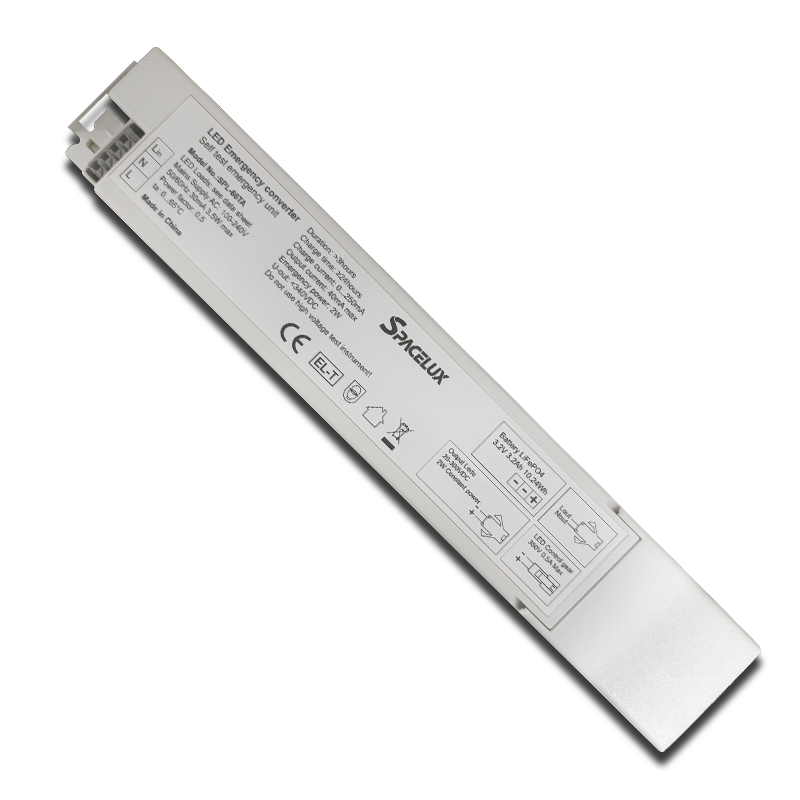
An LED emergency driver is a battery-backed electronic device that automatically powers an LED luminaire during a mains power failure, providing 1 to 3 hours of reduced emergency lighting. It works alongside the standard LED driver and activates within seconds of an outage, ensuring compliance with EN 1838 and EN 61347-2-7 safety standards.
Definition and Core Function
An LED emergency driver is a self-contained electronic device that provides backup power to an LED luminaire when the normal mains supply fails. Unlike a standard LED driver — which only converts mains AC to the DC your LED needs under normal operation — an emergency driver includes an internal battery, charging circuitry, and an inverter that kicks in automatically within milliseconds of a power outage.
In practice, this means that when the lights go out in a corridor, stairwell, or open-plan office, the LED emergency driver ensures that critical egress lighting stays on — typically at a reduced lumen output — for a mandated minimum duration, usually 1 to 3 hours depending on local regulations.
How Does an LED Emergency Driver Work?
Understanding how an LED emergency driver works is essential for anyone specifying, installing, or maintaining emergency lighting systems. Here’s the sequence:
- Normal Operation (Mains On): The mains AC supply powers the primary LED driver, which drives the LED load at full brightness. Simultaneously, the emergency driver’s charging circuit draws a small current to maintain its internal battery at full capacity. An indicator LED (typically green) confirms the battery is charging.
- Power Failure Detected: When the mains supply drops below a threshold (typically around 85% of nominal voltage), the emergency driver’s monitoring circuit detects the failure within milliseconds.
- Switchover to Battery: The emergency driver’s inverter converts the battery’s DC output into the appropriate drive current for the LED load. This switchover happens almost instantaneously — usually within 0.5 to 5 seconds, well within regulatory limits.
- Emergency Mode (Battery Discharge): The LED operates at reduced output — typically 10-25% of normal lumen levels, depending on the driver specification and battery capacity. This reduced output extends the runtime to meet the minimum 1-hour or 3-hour requirement.
- Mains Restored: When mains power returns, the emergency driver switches back to charging mode, and the primary LED driver resumes full-power operation. The battery begins recharging, typically reaching full capacity within 12-24 hours.
LED Emergency Driver vs. Standard LED Driver
| Feature | Standard LED Driver | LED Emergency Driver |
|---|---|---|
| Primary Function | Converts AC mains to DC for LED operation | Provides battery-backed DC during power failure |
| Battery | None | Internal (LiFePO4, NiCd, or NiMH) |
| Operation During Outage | Stops working | Activates emergency output |
| Output During Emergency | N/A | Reduced (typically 10-25% of normal) |
| Certification Needs | CE, RoHS, ENEC | CE, EN 61347-2-7, EN 1838 (Europe); UL 924 (US) |
| Typical Cost | Low | Moderate to high (battery + electronics) |
A common misunderstanding is that an LED emergency driver replaces the standard driver. In most configurations, the emergency driver works alongside the primary driver — it only activates when the primary driver loses power. This is a critical distinction for installation and wiring.
Types of LED Emergency Drivers Explained
Constant Power Emergency Drivers
Picture this: you’re retrofitting 200 downlights in a 2010-vintage office building, and nobody can tell you the exact forward voltage of the LED modules inside. A constant power emergency driver solves this problem — it delivers a fixed wattage regardless of the LED’s Vf, so the output current adjusts automatically. You get the same emergency light output every time, even with unknown LED bins.
Best for: Projects where you need predictable, guaranteed emergency light output regardless of LED binning variations. Constant power drivers are especially common in commercial retrofit applications where you’re adding emergency capability to existing luminaires with unknown Vf characteristics.
Advantage: Consistent lumen output across different LED loads. If the spec says 5W emergency output, you get 5W — every time.
Constant Current Emergency Drivers
Constant current emergency drivers deliver a fixed current (measured in milliamps) to the LED load. The output voltage varies based on the LED’s forward voltage characteristic.
Best for: New-build projects where the LED load is precisely specified and matched to the driver. Also ideal for linear LED modules and COB (Chip-on-Board) LEDs that require tightly regulated current.
Advantage: More efficient when the LED load is well-characterized. Tends to produce less thermal stress on the LED, potentially extending both the LED and driver life.
Constant Voltage Emergency Drivers
Constant voltage emergency drivers output a fixed voltage (typically 12V DC or 24V DC) and are designed for LED strips, modules, or fixtures that include their own current-limiting resistors or internal drivers.
Best for: LED tape light installations, architectural accent lighting with emergency requirements, and fixtures with built-in constant-current regulators that simply need a stable voltage supply.
Advantage: Versatile — can drive any load designed for that voltage. Simpler to specify for low-voltage LED systems.
Which Type Is Right for Your Project?
| Project Type | Recommended Type | Why |
|---|---|---|
| Office/Commercial Retrofit | Constant Power | Guarantees output regardless of existing LED specs |
| New Construction (Specified LEDs) | Constant Current | Maximum efficiency, matched performance |
| LED Strip/Tape Emergency | Constant Voltage | Matches the voltage-driven architecture |
| Industrial High Bay | Constant Power | Handles varying Vf across high-power arrays |
| Healthcare Corridor Lighting | Constant Current | Precise lumen control for code compliance |
Need help matching the right driver type to your project? SpaceLux offers free compatibility assessments — send us your luminaire specs and we’ll recommend the optimal emergency driver within 24 hours.
Maintained vs. Non-Maintained Emergency Lighting Modes
Maintained Mode Explained
In maintained mode, the emergency luminaire operates normally during mains power — just like any standard light fitting. When the power fails, it continues to operate at reduced output using the emergency driver’s battery.
Maintained luminaires are always “on” — they simply switch to battery power when mains is lost. You’ll commonly find these in:
- Exit signs that are illuminated 24/7
- Public corridors and stairwells require constant illumination
- Cinemas, theatres, and entertainment venues (where some fixtures double as normal and emergency lighting)
Non-Maintained Mode Explained
In non-maintained mode, the emergency luminaire is off during normal mains operation. It only activates when the power fails, switching on at reduced output via the battery-backed emergency driver.
Non-maintained luminaires are the more common choice for:
- Office buildings (corridors that don’t need constant lighting)
- Industrial facilities (where normal lighting is sufficient during operation)
- Storage areas and plant rooms
When to Choose Each Mode
| Factor | Maintained | Non-Maintained |
|---|---|---|
| Luminaire always visible? | Yes | No (off until needed) |
| Typical application | Exit signs, 24/7 corridors | Office corridors, storerooms |
| Battery wear | Higher (more charge cycles) | Lower (activates only during outages) |
| Cost implication | Slightly higher (continuous operation) | Slightly lower |
| EN 1838 requirement | Must maintain min. 1 lux on escape routes | Same emergency performance when activated |
| Aesthetic impact | Invisible until the emergency | Invisible until emergency |
The choice between maintained vs non-maintained LED emergency driver operation isn’t just technical — it’s driven by building use, regulatory requirements, and the occupant experience you’re designing for.
Battery Technology: LiFePO4 vs. NiCd vs. NiMH
The battery is the heart of any LED emergency driver. It determines runtime, lifespan, maintenance intervals, and total cost of ownership. Here’s how the three main chemistries compare.
LiFePO4 Batteries — The New Standard
Lithium Iron Phosphate (LiFePO4) is rapidly becoming the preferred battery technology for modern LED emergency drivers. With a cycle life of 2,000-5,000 charge-discharge cycles — roughly 3-5 times that of NiCd — LiFePO4 batteries can last the entire rated life of the emergency driver, eliminating mid-life battery replacements.
Key advantages:
- Exceptional cycle life (2,000-5,000 cycles)
- Stable chemistry with no thermal runaway risk
- Lightweight and compact
- Low self-discharge rate (2-3% per month)
- Environmentally friendlier (no cadmium or heavy metals)
NiCd Batteries — The Legacy Option
Nickel-Cadmium (NiCd) has been the industry standard for decades. While reliable and well-understood, NiCd batteries suffer from memory effect, limited cycle life (500-1,000 cycles), and contain toxic cadmium — increasingly restricted under EU RoHS directives.
Still used because:
- Wide operating temperature range (-20°C to +50°C)
- Proven track record in emergency lighting
- Lower upfront cost
Drawbacks:
- Battery replacement is typically required every 3-5 years
- Memory effect reduces effective capacity over time
- Cadmium disposal restrictions under EU regulations
NiMH Batteries — The Middle Ground
Nickel-Metal Hydride (NiMH) offers higher energy density than NiCd without the toxic cadmium. However, NiMH has a shorter cycle life and higher self-discharge rate, making it less suitable for emergency lighting applications where the battery must remain at full charge for months between power events.
Limited use because:
- Higher self-discharge (20-30% per month)
- Shorter cycle life than NiCd (300-500 cycles)
- More sensitive to temperature extremes
Battery Comparison Table
| Parameter | LiFePO4 | NiCd | NiMH |
|---|---|---|---|
| Cycle Life | 2,000-5,000 | 500-1,000 | 300-500 |
| Typical Replacement Interval | 8-12 years | 3-5 years | 2-4 years |
| Energy Density | High | Medium | Medium-High |
| Self-Discharge (per month) | 2-3% | 15-20% | 20-30% |
| Operating Temperature | -10°C to +55°C | -20°C to +50°C | 0°C to +40°C |
| Memory Effect | None | Yes | Minimal |
| Toxicity | Low | High (Cadmium) | Low |
| Weight (relative) | Light | Heavy | Medium |
| Upfront Cost | Higher | Lower | Medium |
| Total Cost of Ownership | Lowest | Higher | Highest |
The shift to LiFePO4 battery LED emergency driver technology isn’t just a trend — it’s an economic imperative. While the upfront cost is higher, eliminating a mid-life battery replacement (typically €15-40 per unit including labor) delivers net savings over the product lifecycle. Explore SpaceLux’s LiFePO4-powered emergency drivers →
A quick story: a facilities management company in the Netherlands contacted us after replacing 400 NiCd-based emergency drivers — every single one failed its annual duration test in year four. The replacement cost, including labor, exceeded €28,000. Had they specified LiFePO4 from the start, those drivers would still be running today, with zero mid-life intervention. Sometimes the “expensive” option is actually the cheap one.
Compliance and Certification: What European B2B Buyers Must Know
For European buyers, compliance isn’t optional — it’s the gateway to market access.
Red flag: If a supplier can only provide a CE Declaration of Conformity without an independent test report to EN 61347-2-7, walk away. Self-declaration is legal but meaningless without lab-backed evidence. We’ve reviewed drivers that passed self-assessment but failed basic thermal testing — and they were installed in a hospital corridor.
Here’s what you actually need to understand.
EN 61347-2-7 — The European Standard
EN 61347-2-7 is the European standard governing DC or AC supplied electronic controlgear for LED modules with emergency operation. It is part of the broader EN 61347 series covering lamp controlgear safety.
What it requires:
- The emergency driver must maintain output for the rated duration (typically 1h or 3h)
- Switchover time must not exceed the limits defined in EN 1838
- The driver must include protections against battery overcharge, over-discharge, and short circuit
- Thermal management must prevent the battery from exceeding safe operating temperatures
EN 1838 — Emergency Lighting Requirements
EN 1838 defines the lighting performance requirements for emergency lighting systems installed in buildings. It specifies:
- Minimum illuminance: 1 lux along the centre line of escape routes (for corridors up to 2m wide)
- Uniformity ratio: The maximum-to-minimum illuminance ratio must not exceed 40:1
- Response time: Emergency lighting must reach 50% of the design illuminance within 5 seconds and full design illuminance within 60 seconds
- Duration: Minimum 1-hour emergency duration (3 hours commonly specified for most building types)
CE Marking and LVD/EMC Directives
Every LED emergency driver sold in the EU must carry the CE mark, indicating compliance with:
- Low Voltage Directive (LVD) 2014/35/EU: Covers electrical safety for equipment operating between 50-1,000V AC or 75-1,500V DC
- Electromagnetic Compatibility (EMC) Directive 2014/30/EU: Ensures the driver doesn’t emit excessive electromagnetic interference and has adequate immunity
- RoHS Directive 2011/65/EU: Restricts hazardous substances (particularly relevant for NiCd batteries)
UL 924 — For North American Certification
If your project requires dual-market compliance (Europe + North America), UL 924 is the relevant standard. It covers emergency lighting and power equipment and is required for products sold in the United States and Canada.
Key differences from European standards:
- UL 924 requires a 90-minute minimum emergency operation (vs. EN 1838’s 1-hour minimum)
- Testing protocols and acceptance criteria differ from IEC/EN methods
- Separate UL listing process required
Compliance Checklist for Procurement
Use this checklist when evaluating LED emergency drivers for European projects:
- EN 61347-2-7 compliance documented (test report or certificate)
- EN 1838 performance requirements met (1h or 3h duration confirmed)
- CE marking is present and valid
- LVD 2014/35/EU declaration of conformity available
- EMC 2014/30/EU declaration of conformity available
- RoHS compliance documented
- Battery chemistry compliant with EU waste directives (WEEE, Battery Directive)
- IP rating appropriate for installation environment
- The manufacturer provides the declared emergency lumen output
- Test certificate from an accredited laboratory (not self-declaration alone)
How to Choose the Right LED Emergency Driver: A Procurement Framework
This six-step framework eliminates the common specification errors that lead to failed inspections, costly replacements, and project delays.
Step 1 — Assess Fixture Compatibility
Before anything else, confirm the emergency driver is compatible with your LED luminaire. Check:
- Input voltage range: Does the emergency driver accept your mains voltage (220-240V for EU)?
- LED load range: Does the driver support your luminaire’s wattage and forward voltage?
- Driver topology match: Is the primary driver constant current, constant voltage, or constant power? The emergency driver must match.
- Physical dimensions: Will the emergency driver fit within the luminaire housing or remote mounting box?
Common pitfall: Assuming all “LED emergency drivers” work with any LED fixture. A constant current emergency driver connected to a constant voltage LED strip will either fail to operate or damage the LEDs.
Step 2 — Determine Output Power Requirements
Calculate the minimum emergency lumen output needed to meet EN 1838 requirements for your specific space:
- Measure or estimate the escape route dimensions
- Apply EN 1838’s minimum illuminance requirement (1 lux along the centre line)
- Convert required lux to lumens using the formula: Lumens = Lux × Area (m²)
- Add a 20-30% margin for optical losses and lumen depreciation
- Match the calculated lumen requirement to the emergency driver’s declared output
Step 3 — Evaluate Battery Runtime Needs
Most European regulations require a minimum 1-hour emergency duration. However, many building types — hospitals, high-rise offices, entertainment venues — are specified with 3-hour requirements.
| Building Type | Typical Duration Requirement |
|---|---|
| Small offices, retail | 1 hour |
| Large offices, educational | 3 hours |
| Hospitals, healthcare | 3 hours |
| Residential (common areas) | 1-3 hours |
| Entertainment venues | 3 hours |
Always verify with your local building control officer or the project’s fire safety engineer.
Step 4 — Consider Environmental Conditions
The installation environment directly impacts driver selection:
- Temperature: Confirm the driver’s rated operating temperature range. Industrial environments may exceed +40°C, requiring extended temperature-rated drivers.
- Humidity and dust: Wet or dusty environments need drivers with appropriate IP ratings (IP65 minimum for damp locations).
- Vibration: For industrial and transportation applications, verify the driver passes IEC 60068-2-6 vibration testing.
- Chemical exposure: In chemical plants or swimming pools, verify resistance to corrosive atmospheres.
Step 5 — Verify Certification Requirements
Match certifications to your market:
| Market | Required Certifications |
|---|---|
| European Union | CE, EN 61347-2-7, EN 1838, LVD, EMC, RoHS |
| United Kingdom | UKCA, BS EN 61347-2-7, BS EN 1838 |
| North America | UL 924, CSA C22.2 No. 141 |
| Middle East | CE + local equivalents (SASO, ESMA) |
| Australia/NZ | AS/NZS 2293, SAA approval |
Step 6 — Calculate Total Cost of Ownership
The cheapest driver at purchase is rarely the cheapest over its service life. Consider:
TCO = Purchase Price + Installation Cost + (Battery Replacements × Number of Replacements) + Maintenance Testing Cost + Disposal Cost
A real-world scenario: For a 200-luminaire project over 10 years:
| Cost Factor | NiCd Driver (€) | LiFePO4 Driver (€) |
|---|---|---|
| Purchase (200 units) | 8,000 | 12,000 |
| Installation | 4,000 | 4,000 |
| Battery Replacements (1x at year 4) | 6,000 | 0 |
| Annual Testing (labor) | 3,000 | 3,000 |
| End-of-Life Disposal | 800 | 200 |
| 10-Year TCO | €21,800 | €19,200 |
Despite a 50% higher purchase price, the LiFePO4 driver delivers 12% lower total cost of ownership — a saving of €2,600 on a 200-unit project.
Installation Guide: Wiring and Setup
Pre-Installation Checklist
Before installing any LED emergency driver, verify:
- Driver model matches the luminaire specification
- Mains voltage matches driver input rating
- Battery is fully charged (or allow 24h charge before first test)
- All wiring complies with local electrical regulations
- Circuit is dedicated (no dimmers, occupancy sensors, or switched live on emergency circuit unless specifically designed for it)
- Mounting location allows adequate ventilation and access for maintenance
Wiring Diagram Overview
A typical LED emergency driver wiring configuration includes:
- Permanent Live (L) + Neutral (N): Connected to the unswitched mains supply — this keeps the battery charging circuit active 24/7.
- Switched Live (SL): Connected to the lighting circuit that controls normal on/off operation (for maintained mode only).
- LED Output (+/-): Connected to the LED load.
- Indicator LED: Shows charging status — must be visible after installation.
Important: The permanent live supply must NEVER be switched off. If the permanent live is interrupted (e.g., by a building management system), the emergency driver will interpret this as a power failure and activate emergency mode, eventually draining the battery.
The #1 installation mistake we see: Electricians connecting the permanent live to the switched circuit. Everything works fine — until the lights are turned off at night, and the emergency driver thinks there’s a power failure. By morning, the battery is dead. Always verify the permanent live is truly unswitched, even if the BMS schedule says it should be on 24/7.
For detailed LED emergency driver wiring diagrams specific to your fixture type, consult the manufacturer’s installation guide or contact SpaceLux technical support.
Step-by-Step Installation Process
- Isolate the mains supply at the distribution board and verify with a voltage tester.
- Mount the emergency driver in the luminaire housing or remote mounting box. Ensure the indicator LED is visible.
- Connect the permanent live and neutral to the driver’s input terminals. Use the correct wire gauge per local regulations.
- Connect the switched live (maintained mode only) to enable normal switching of the luminaire.
- Connect the LED output wires to the LED load. Observe correct polarity.
- Restore mains power and verify the indicator LED shows charging status (typically solid green).
- Allow 24 hours for the battery to reach full charge before conducting the first emergency test.
Post-Installation Testing and Commissioning
After installation and full battery charge:
- Functional test: Isolate the mains supply to the emergency circuit. The luminaire should activate in emergency mode within 5 seconds.
- Duration test: Keep the mains isolated and verify the emergency output maintains for the rated duration (1h or 3h). Log the results.
- Illuminance measurement: At floor level along the escape route, measure emergency illuminance with a lux meter. Confirm compliance with EN 1838 minimum requirements.
- Restore mains and verify the indicator LED returns to charging status.
- Document all test results in the building’s emergency lighting log.
Troubleshooting Common LED Emergency Driver Issues
Emergency Mode Fails to Activate
Possible causes:
- Battery not fully charged (insufficient charge time after installation or prolonged mains failure)
- Permanent live supply is being switched off by the BMS or the timer
- Battery has reached the end of life (typical for NiCd after 3-5 years)
- Faulty switchover relay or monitoring circuit
Resolution: Check permanent live supply integrity first. Then test battery voltage under load. If the voltage drops below the threshold under load, replace the battery or the entire driver unit.
Insufficient Emergency Light Output
Possible causes:
- Emergency driver wattage too low for the LED load
- Battery degraded (reduced capacity)
- Incorrect LED load connection (mismatched driver type)
- Lens or diffuser blocking too much light
Resolution: Verify the driver’s declared emergency output matches your project’s lumen requirements. If the battery is more than 3-4 years old (NiCd), schedule replacement.
Battery Not Charging Properly
Possible causes:
- Permanent live supply interrupted
- Charging circuit fault within the driver
- The battery has developed an internal short (common with aged NiCd cells)
- Ambient temperature exceeding rated range
Resolution: Check the indicator LED status. A flashing or off indicator typically signals a charging fault. Measure the charging voltage at the battery terminals. If out of specification, replace the driver.
Indicator Light Error Codes
Most modern LED emergency drivers use the indicator LED to communicate status:
| LED Status | Meaning |
|---|---|
| Solid green | Battery fully charged, system ready |
| Flashing green | Battery charging (normal after mains restore) |
| Solid red | Battery fault or failed test |
| Flashing red | Charging circuit fault |
| No LED | No mains supply to the driver or the driver failed |
Always refer to the specific manufacturer’s documentation for exact error code definitions.
LED Emergency Driver FAQ
How long do LED emergency drivers last? A quality LiFePO4-based emergency driver typically lasts 8-12 years. NiCd-based units usually need battery replacement every 3-5 years.
Can I use any LED emergency driver with any LED fixture? No. The emergency driver type (constant power, constant current, or constant voltage) must match the LED load. A mismatched driver will either fail to operate or damage the LEDs.
What’s the difference between maintained and non-maintained emergency lighting? Maintained luminaires stay on all the time and switch to battery when mains fails. Non-maintained luminaires are off during normal operation and only activate during a power failure.
Is CE marking enough for European compliance? CE marking is legally required but not sufficient on its own. You should also verify EN 61347-2-7 compliance via an independent test report, plus EN 1838 performance requirements for the installed system.
Do LED emergency drivers need regular testing? Yes. EN 1838 and most national regulations require monthly functional tests and annual duration tests. Smart (DALI-2) drivers can automate this process.
Market Outlook: LED Emergency Driver Trends in 2026 and Beyond
IoT-Enabled Smart Emergency Drivers
The emergency lighting industry is undergoing a quiet revolution. IoT-enabled LED emergency drivers can now communicate wirelessly with building management systems, providing real-time status monitoring, automated test scheduling, and instant fault alerts — eliminating the need for manual monthly and annual testing walks.
Industry data suggests IoT-enabled emergency lighting systems can reduce maintenance costs by 40-50% compared to traditional manual testing regimes. For facilities managers overseeing hundreds or thousands of emergency luminaires, this translates to significant labor savings and faster fault resolution.
The Shift to LiFePO4 Battery Technology
The transition from NiCd to LiFePO4 is accelerating. Several factors are driving this:
- EU RoHS restrictions on cadmium are tightening, making NiCd increasingly difficult to justify
- Lifecycle economics favor LiFePO4 — eliminating mid-life battery replacements delivers net savings
- Weight and size advantages allow more compact driver designs, fitting into slimmer luminaires
- Sustainability mandates — green building certifications (BREEAM, LEED) reward products with lower lifecycle environmental impact
Integration with Building Management Systems
Modern emergency drivers increasingly support DALI-2 Emergency (IEC 62386-202) and other digital protocols, enabling:
- Remote status monitoring of every emergency luminaire
- Automated monthly and annual function/duration testing
- Centralized test result logging for compliance documentation
- Real-time fault notifications via email or BMS dashboard
For large commercial projects, DALI-2 emergency driver integration is rapidly becoming a specification requirement rather than an optional feature.
Sustainability and Green Building Certifications
BREEAM and LEED certification requirements increasingly reward:
- Extended product lifespans (LiFePO4 drivers with 10+ year battery life)
- Reduced maintenance interventions (smart self-testing drivers)
- Lower embodied carbon (compact, efficient driver designs)
- End-of-life recyclability (LiFePO4 batteries are easier to recycle than NiCd)
Specifying sustainable emergency drivers isn’t just an environmental choice — it’s increasingly a competitive advantage in project bidding.
Why SpaceLux LED Emergency Drivers
Product Range Overview
SpaceLux offers a comprehensive range of LED emergency drivers engineered for European commercial and industrial applications:
- Constant power, constant current, and constant voltage options covering 3W to 50W emergency output
- LiFePO4 battery technology standard across the range — no mid-life battery replacements
- 1-hour and 3-hour duration options to meet all EN 1838 requirements
- Maintained and non-maintained configurations
- DALI-2 Emergency compatible models for smart building integration
- Compact form factors designed for easy retrofit into existing luminaire housings
European Certification Compliance
Every SpaceLux LED emergency driver is:
- Tested and certified to EN 61347-2-7 by accredited European laboratories
- Designed to meet EN 1838 emergency lighting performance requirements
- CE marked with full LVD and EMC declarations of conformity
- RoHS compliant — no cadmium, no restricted substances
- Supported with complete technical documentation for project specification and building control submission
B2B Support and Custom Solutions
We understand that B2B procurement isn’t one-size-fits-all. SpaceLux provides:
- Free compatibility assessments — send us your luminaire specs, and we’ll recommend the right driver
- Custom output configurations for project-specific requirements
- Volume pricing with tiered discounts for distribution and project orders
- Technical documentation packages, including wiring diagrams, test certificates, and specification sheets
- Dedicated account management for ongoing supply partnerships
Ready to specify SpaceLux LED emergency drivers for your next project? Contact our B2B team for a custom quote — most inquiries are answered within 24 hours.
Conclusion
The right LED emergency driver is the one you never have to think about after installation. It works when the power doesn’t. It passes inspection the first time. And it doesn’t need a battery swap halfway through its rated life.
If you take one thing from this guide: specify LiFePO4, demand lab-backed EN 61347-2-7 certificates, and double-check that permanent live. Those three decisions eliminate the majority of emergency lighting failures we encounter.
The market is moving fast — smart drivers, DALI integration, and LiFePO4 batteries are reshaping expectations. Buyers who adapt now will avoid the costly retrofit cycle that’s coming for anyone still specifying NiCd.
Need a second opinion on your next specification? The SPACELUX team reviews luminaire specs and recommends compatible emergency drivers — usually within 24 hours.


