The rapid global adoption of LED technology has transformed the lighting industry by offering superior energy efficiency, long lifespan, and flexible design possibilities. However, alongside these benefits, LEDs have introduced a critical performance challenge that is often overlooked: the flicker phenomenon in LED lighting.
Unlike traditional incandescent lamps, which emit light continuously due to thermal inertia, LED light output is highly dependent on its electrical input. Any fluctuation in current or voltage can directly translate into fluctuations in light intensity, resulting in flicker. While some flicker is visible to the human eye, much of it remains invisible yet still capable of causing discomfort, reduced visual performance, and long-term health concerns.
This article provides a feature-aligned, in-depth explanation of the flicker phenomenon in LED lighting, focusing on its technical causes, classification, biological impact, measurement standards, and proven prevention strategies. The goal is to support lighting designers, engineers, manufacturers, and end users in achieving stable, flicker-free LED systems.
Understanding the Flicker Phenomenon in LED Lighting
What Is LED Flicker?
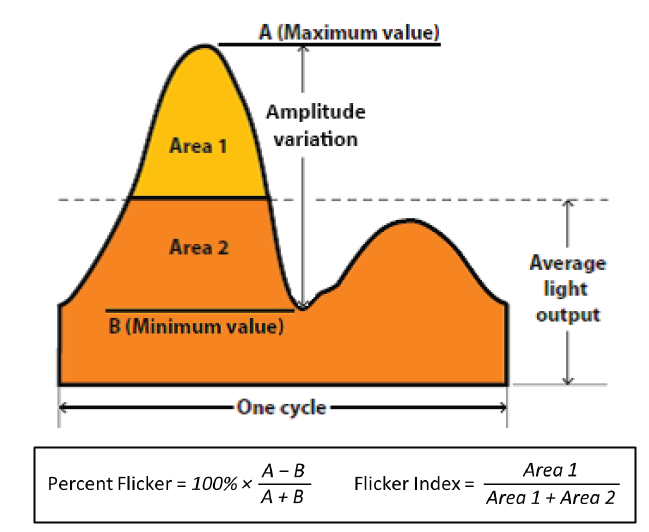
The flicker phenomenon in LED lighting refers to rapid, repetitive variations in light output intensity caused by electrical or electronic factors within the lighting system. These variations may occur at frequencies ranging from a few hertz to several kilohertz.
Flicker can be:
- Visible, where the human eye perceives brightness fluctuations
- Invisible, where flicker is not consciously seen but still affects the nervous system and visual processing
LED flicker is not inherent to the LED chip itself but is primarily a consequence of driver design, power quality, and control methods.
Why Flicker Occurs in LED Systems
1. Dependence on Electrical Input
LEDs are current-driven semiconductor devices. Any instability in:
- Input voltage
- Output current
- Power frequency
will directly modulate light output.
Unlike incandescent lamps, LEDs lack thermal buffering, making them extremely responsive to electrical variations.
2. AC to DC Conversion
Most power grids supply alternating current (AC), while LEDs require direct current (DC). This conversion is handled by the LED driver.
If rectification and smoothing are insufficient:
- The output current follows the AC waveform
- Light output rises and falls at twice the mains frequency (100 Hz or 120 Hz)
- Flicker becomes unavoidable
3. Poor Driver Design
Low-cost or poorly engineered LED drivers often:
- Use minimal filtering capacitors
- Lack of constant-current regulation
- Fail to suppress ripple voltage
These deficiencies are among the primary causes of the flicker phenomenon in LED lighting.
Types of LED Flicker
1. Visible Flicker
Visible flicker typically occurs below 80 Hz and is immediately noticeable as:
- Shimmering light
- Pulsating brightness
- Stroboscopic effects
This type is unacceptable in professional lighting environments.
2. Invisible Flicker
Invisible flicker occurs at higher frequencies (>100 Hz) and cannot be consciously seen. However, it can still:
- Cause headaches
- Increase eye strain
- Reduce concentration
- Trigger migraines or neurological responses
Invisible flicker is particularly dangerous because users may not recognize symptoms as a result of poor lighting quality.
3. Stroboscopic Effect
High-frequency flicker can interact with moving objects, creating:
- Apparent motion distortion
- False stop-motion effects
- Safety risks in industrial environments
This is critical in factories, workshops, and healthcare facilities.
Health and Performance Impacts of LED Flicker
1. Human Visual System Response
The human brain processes visual signals continuously, even when flicker is not consciously perceived. Prolonged exposure to flicker can overload the visual cortex, leading to fatigue.
2. Documented Health Effects
Studies associate the flicker phenomenon in LED lighting with:
- Headaches and migraines
- Eye strain and dryness
- Reduced reading speed
- Poor task accuracy
- Increased stress levels
Children, elderly individuals, and people with neurological sensitivity are especially vulnerable.
3. Workplace Productivity
In office and industrial settings, flicker can:
- Reduce worker efficiency
- Increase error rates
- Cause discomfort complaints
- Lead to higher absenteeism
Thus, flicker control is not only a health issue but also an economic one.
Flicker Metrics and Measurement Standards
1. Percent Flicker
Percent Flicker measures the amplitude variation between maximum and minimum light output.
- Simple to calculate
- Does not account for frequency
- Limited usefulness alone
2. Flicker Index
Flicker Index considers:
- Light waveform shape
- Duty cycle
- Modulation depth
It provides a more accurate assessment of flicker severity.
3. IEEE 1789 Standard
The IEEE 1789-2015 standard defines:
- Safe modulation limits
- Recommended frequency ranges
- Risk zones for human health
Compliance with IEEE 1789 is a key benchmark for flicker-free LED products.
4. PstLM and SVM Metrics
Modern standards such as IEC TR 61547-1 introduce:
- PstLM (short-term flicker)
- SVM (stroboscopic visibility measure)
These metrics are increasingly required in professional lighting specifications.
Root Causes of the Flicker Phenomenon in LED Lighting
1. Insufficient Output Filtering
Lack of adequate smoothing capacitors results in current ripple directly driving LED chips.
2. Phase-Cut Dimming Incompatibility
Traditional TRIAC dimmers:
- Chop AC waveforms
- Create irregular current delivery
- Causes severe flicker if drivers are incompatible
3. PWM Dimming at Low Frequencies
Pulse Width Modulation (PWM) is widely used for controlling the brightness of LEDs. However:
- Low PWM frequency (<1 kHz) increases flicker risk
- Poorly implemented PWM worsens stroboscopic effects
4. Power Quality Issues
Voltage fluctuations, harmonics, and unstable grids can amplify flicker in LED systems lacking proper regulation.
Proven Methods for Flicker Prevention in LED Lighting
1. Use High-Quality Constant-Current Drivers
The most effective way to eliminate flicker is to use:
- Constant-current LED drivers
- Active ripple suppression
- High-frequency switching designs
Professional drivers significantly reduce modulation depth.
2. Increase Output Capacitance and Filtering
Proper filtering:
- Smooths rectified DC
- Reduces ripple current
- Stabilizes light output
This is a foundational design requirement for flicker-free performance.
3. High-Frequency PWM Dimming
If PWM dimming is required:
- Use frequencies above 2 kHz
- Ensure stable duty cycles
- Avoid low-frequency modulation at dimmed levels
High-frequency PWM minimizes biological impact.
4. DC Dimming (CCR Method)
Constant Current Reduction (CCR) dimming:
- Adjusts current amplitude
- Maintains continuous light output
- Eliminates PWM-related flicker
CCR is preferred for offices, hospitals, and studios.
5. Flicker-Compatible Dimming Systems
Use dimming protocols designed for LEDs, such as:
- DALI
- 0–10V
- DMX with proper drivers
Avoid legacy dimmers unless explicitly rated for LED compatibility.
6. Compliance with Flicker Standards
Select luminaires tested and certified for:
- IEEE 1789 compliance
- Low PstLM and SVM values
- Flicker-free or low-flicker labeling
This ensures measurable, verifiable performance.
7. System-Level Design Optimization
Flicker prevention must consider:
- Driver-LED compatibility
- Power supply quality
- Control interface integration
- Installation conditions
A holistic approach ensures consistent results across applications.
Flicker Prevention by Application
Residential Lighting
- Use flicker-free LED bulbs
- Avoid cheap dimmers
- Prioritize driver quality
Office and Commercial Spaces
- Specify IEEE 1789-compliant fixtures
- Use DC or high-frequency dimming
- Monitor PstLM limits
Industrial Environments
- Eliminate stroboscopic effects
- Use high-output constant-current drivers
- Ensure safety compliance
Healthcare and Education
- Zero-visible flicker is mandatory
- Protect sensitive populations
- Enhance concentration and comfort
Future Trends in Flicker-Free LED Technology
Advancements include:
- Digital constant-current drivers
- Active flicker compensation circuits
- Smart lighting systems with adaptive regulation
- AI-based power quality monitoring
These innovations continue to reduce the flicker phenomenon in LED lighting, improving both performance and human well-being.
Conclusion
The flicker phenomenon in LED lighting is a technically complex yet critically important aspect of modern lighting design. While LED technology offers remarkable advantages, poor driver design, inadequate power conditioning, and incompatible dimming methods can introduce harmful flicker effects.
By understanding the root causes, adopting standardized measurement metrics, and implementing proven prevention techniques, manufacturers and designers can deliver safe, comfortable, and truly flicker-free LED lighting systems.
Investing in flicker prevention is not merely a technical upgrade—it is a commitment to human health, visual comfort, and lighting excellence.