What is UGR?
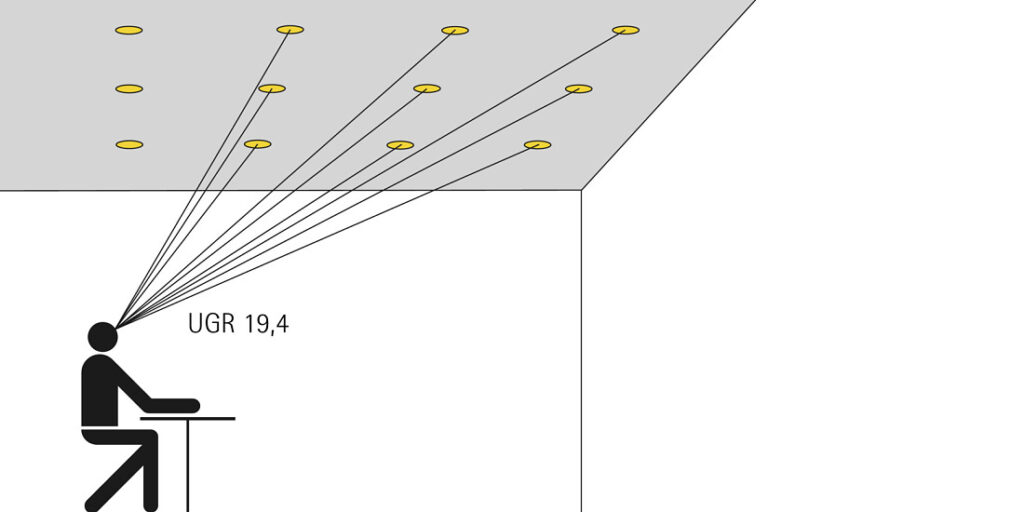
UGR, namely Unified Glare Rating, which is translated into Chinese as Unified Glare Level, is an objective indicator for evaluating the degree of indoor lighting glare formulated by the International Commission on Illumination (CIE).
It quantifies the visual discomfort caused to the human eye by the light emitted by lighting equipment—the lower the UGR value, the less glare and the higher the visual comfort.
The UGR value does not measure the quality of the lamp itself, but rather assesses the impact of light on the observer in a specific lighting installation environment.
A lighting environment with a low UGR value can reduce discomfort symptoms such as eye fatigue and headaches, and improve work efficiency and quality of life.
The calculation method of UGR
The calculation of UGR is rather complex and usually requires the use of professional lighting design software (such as Dialux, Relux, etc.) for simulation calculations.
The calculation process takes into account multiple factors, including lamp brightness, light distribution, lamp position, observer position, and room reflectivity, among others.
In short, the UGR value is influenced by the following factors:
Luminance: The higher the surface luminance, the higher the UGR value.
Angular Distribution: The higher the concentration of light, the higher the UGR value. Narrow beams are more likely to cause glare.
The smaller the Angle between the lamp and the observer’s line of sight, the higher the UGR value.
Background Luminance: The darker the background, the higher the UGR value.
Lamp Size (Size): The larger the lamp size, the higher the UGR value may be
UGR values and different application scenarios
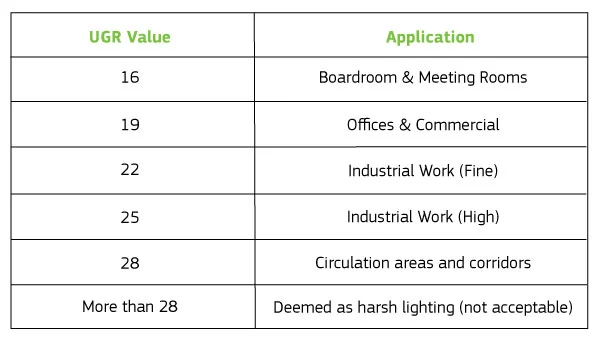
The tolerance for UGR values varies in different environments. For instance, in places that require high visual accuracy (such as operating rooms), the UGR value needs to be controlled at a very low level (for example, UGR<10); For some places with relatively lower visual requirements (such as warehouses), a higher UGR value (for example, UGR<28) can be tolerated.
The EN 12464 standard provides the recommended range of UGR values for different workplaces, which offers an important reference for lighting designers. It is usually recommended that the UGR be less than 19 for offices and classrooms.
How to reduce the UGR value?
To reduce the UGR value, it is necessary to start from the lighting design and the selection of lamps
Select appropriate lighting fixtures: Choose lighting fixtures with good light distribution and low glare characteristics, such as those with diffusers or grilles.
Arrange the lighting fixtures reasonably: Avoid direct exposure of the fixtures to the observer’s eyes. Indirect lighting or upward lighting schemes can be adopted.
Control the brightness of the lamps: Select the appropriate power of the lamps as needed to avoid excessive brightness.
Enhance background brightness: By increasing the reflectivity of walls and ceilings, the background brightness is enhanced, and the light contrast is reduced.
Use an intelligent lighting control system: By adjusting the brightness of the lamps and the distribution of light, the lighting environment can be dynamically adjusted to meet different needs.
The relationship between UGR and other lighting indicators:
UGR is merely an important indicator to be considered in lighting design, and it is interrelated with other indicators such as illuminance, color rendering, and color temperature. Insufficient illuminance or poor color rendering can also affect visual comfort.
Therefore, in lighting design, these factors need to be comprehensively considered in order to create a comfortable and efficient lighting environment.
Conclusion
UGR is an important indicator for evaluating indoor lighting glare, which is directly related to visual comfort and work efficiency.
Through reasonable lighting design and lamp selection, the UGR value can be effectively reduced, creating a more comfortable and healthier working and living environment.
When choosing LED lamps, attention should be paid to their UGR value, and appropriate lamps and lighting solutions should be selected based on specific application scenarios.